
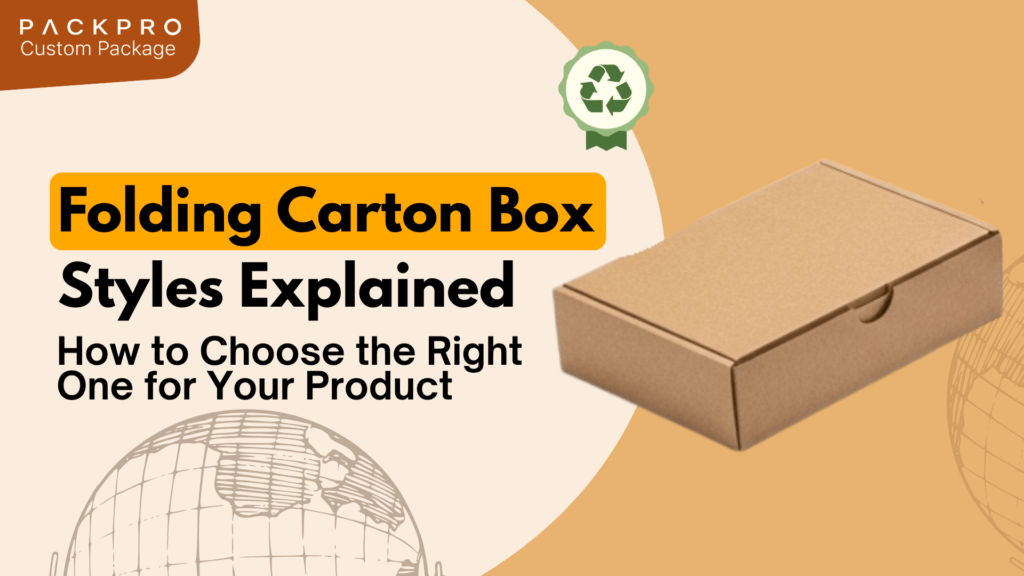
Choosing the right folding carton box style is a critical decision for brand owners and procurement managers. It directly impacts product protection, assembly speed, retail presence, and budget. With multiple structural options available, understanding the practical differences between each style helps you select the format that best fits your product, production environment, and commercial goals.
Quick answer: The right folding carton style depends on your product weight, filling method, and shelf presentation needs. Straight tuck end boxes work best for lightweight retail products. Reverse tuck end boxes suit automated packing lines. Seal end boxes offer stronger closure for heavier items. Auto-lock bottom boxes combine speed and stability for mid-weight products.
Start With Product Requirements
Before evaluating box styles, confirm the key product parameters that will constrain your structural options. These include the weight of the product, its fragility, the dimensions required, whether the box will be hand-filled or machine-filled, and whether it needs to be reclosed after opening. Each of these factors narrows the field of appropriate options significantly.
A lightweight cosmetic product filled by hand in a retail operation has entirely different structural requirements than a dense food product on an automated packing line. Matching the box style to these operational realities prevents costly specification errors that only become apparent during production or distribution.
Straight Tuck End: The Standard Retail Choice
The straight tuck end box is the most widely used folding carton configuration for retail packaging. Both top and bottom flaps tuck inward in the same direction, creating a clean, consistent appearance on all four panels when closed. It is easy to open for consumers and straightforward to fill and close on semi-automated or manual packing lines.
Its primary limitation is closure strength. The tuck flap provides adequate security for lightweight products but is not appropriate for heavier items where the weight of the contents can cause the bottom flap to release during handling or shipping. For products within the appropriate weight range, the straight tuck end delivers excellent retail presentation at competitive production cost.
Reverse Tuck End: Designed for Automation
In a reverse tuck end box, the top and bottom flaps tuck in from opposite directions. This opposing tuck direction is specifically engineered to prevent accidental opening on automated packing lines, where the box passes through filling and closing machinery at speed. The reversed configuration provides mechanical resistance to the forces that would cause a straight tuck end to pop open at high throughput speeds.
For brands running high-volume automated packing operations, the reverse tuck end is typically the preferred specification. The appearance of the finished box is nearly identical to a straight tuck end from the consumer’s perspective, making the choice primarily an operational engineering decision rather than a brand one.
Seal End: Maximum Closure Strength
Seal end boxes replace tuck flap closures with panels that are glued shut during assembly, creating a permanently sealed base and a tucked or hinged top opening. The glued base provides significantly greater structural integrity than a tuck flap, making seal end boxes the appropriate choice for heavier products, products with sharp edges, or applications where base failure during transit would result in product damage or loss.
The trade-off is that seal end boxes are not reclosable after opening, which is acceptable for most retail and food applications but may be a limitation for products where consumer resealing is expected. Production cost is slightly higher than straight or reverse tuck end boxes due to the additional gluing step.
Auto-Lock Bottom: Speed and Stability Combined
The auto-lock bottom, also called a crash-lock bottom, features a base that assembles automatically when the flat box is popped open, with interlocking flaps that form a strong, stable base without adhesive. The top typically uses a standard tuck closure. This format is particularly valued for hand-packing operations where speed matters, as the base requires no manual closure step.
Auto-lock bottom boxes offer a balance between the ease of assembly of a straight tuck end and the structural stability of a seal end. They are commonly used for cosmetics, candles, and mid-weight consumer goods where a reliable base is needed but the production volume does not justify fully automated closure.