
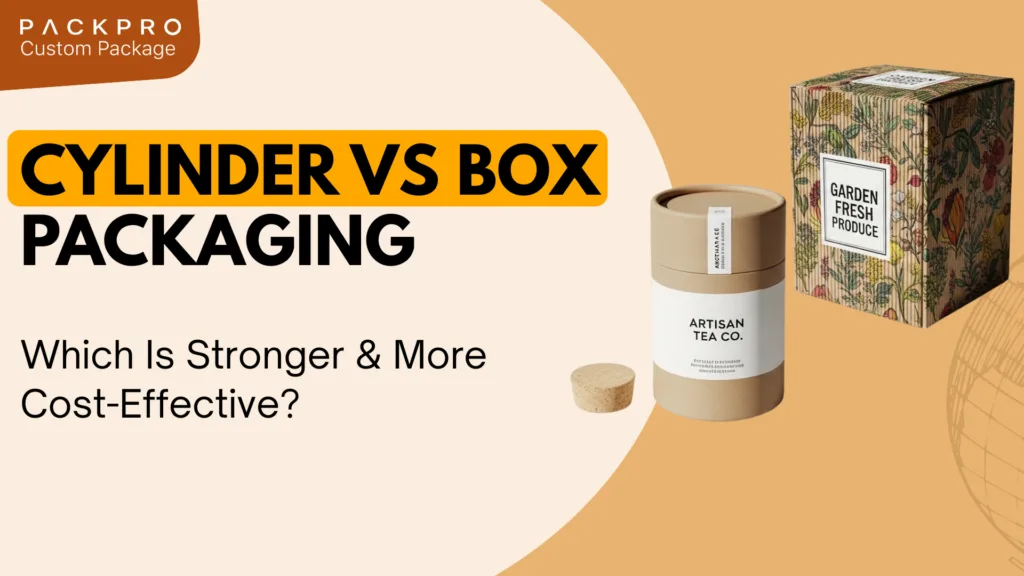
Quick Answer: Which Packaging Is Stronger & Cheaper?
When comparing pure vertical compression strength, cylinder packaging outperforms box packaging of similar dimensions. However, rectangular box packaging is significantly more cost-effective to produce, ship, and store. For most commercial applications, the cost and logistics advantages of box packaging outweigh the structural advantages of cylinder formats.
Choosing between cylinder and box packaging requires evaluating the specific requirements of the product, the distribution environment, and the brand positioning. This guide breaks down both formats across the factors that matter most to procurement managers and brand owners.
Structural Strength: How Each Format Performs
Cylinder packaging derives its strength from the circular geometry of the tube. A cylinder distributes compressive force evenly around its circumference, which means it can resist considerable top-to-bottom pressure without deforming. This is particularly relevant for products that are stacked during storage or shipping.
Rectangular box packaging concentrates stress at corners and along edges. While modern corrugated and rigid box constructions are engineered to handle significant compressive loads, the physics of rectangular geometry mean that equivalent material used in a cylinder would produce a structurally stronger container.
In practical packaging applications, this structural difference rarely determines format selection. Most products do not require the maximum compressive resistance that cylinders provide, and the structural performance of well-specified rectangular packaging is adequate for the vast majority of commercial applications.
Production Cost: The Clear Advantage of Box Packaging
Rectangular box packaging is significantly less expensive to produce than cylinder packaging at comparable specifications. The manufacturing process for boxes is highly optimized, with efficient material utilization and fast automated production. Tooling costs are lower, material waste is reduced, and production throughput is higher.
Cylinder packaging requires more complex manufacturing, including winding layers of kraft paper to create the tube body, applying end caps, and fitting closures. This process is inherently more labour-intensive and produces more material waste than flat sheet die-cutting for rectangular boxes. The per-unit production cost of cylinder packaging is typically higher than box packaging at equivalent volumes.
Logistics Efficiency: Storage and Shipping
Rectangular packaging is significantly more efficient for storage and shipping. Boxes tessellate perfectly, which means they can be packed into pallets and shipping containers with minimal wasted space. This efficiency directly reduces shipping cost per unit and storage cost per cubic metre.
Cylinder packaging cannot be stacked or packed with the same geometric efficiency as rectangular boxes. The circular cross-section leaves air gaps between adjacent units in any packing configuration, which increases the volume occupied per unit and reduces shipping density. For high-volume operations, this packing inefficiency can produce significant additional logistics cost over time.
Brand Differentiation: When Cylinders Justify Their Cost
Despite the cost and logistics disadvantages, cylinder packaging commands a meaningful premium in specific product categories. Luxury spirits, premium teas, fine chocolates, high-end cosmetics, and limited edition products regularly use cylinder packaging because its unconventional format creates immediate visual differentiation on shelf and communicates premium positioning through its distinctive silhouette.
In categories where shelf differentiation and gift appeal are primary purchase drivers, the additional cost of cylinder packaging can be justified by the commercial premium it supports. The decision requires evaluating the category dynamics and the degree to which packaging format contributes to willingness to pay at the intended price point.
Making the Right Choice for Your Product
For most commercial products, rectangular box packaging offers the best balance of cost, logistics efficiency, and structural performance. For products positioned at the premium or luxury tier in categories where visual differentiation is a key purchase driver, cylinder packaging may justify its additional cost through the commercial premium it supports.
The decision should be based on a clear analysis of unit economics across the full product lifecycle, including production cost, shipping cost, storage cost, and the incremental revenue attributable to packaging format.