
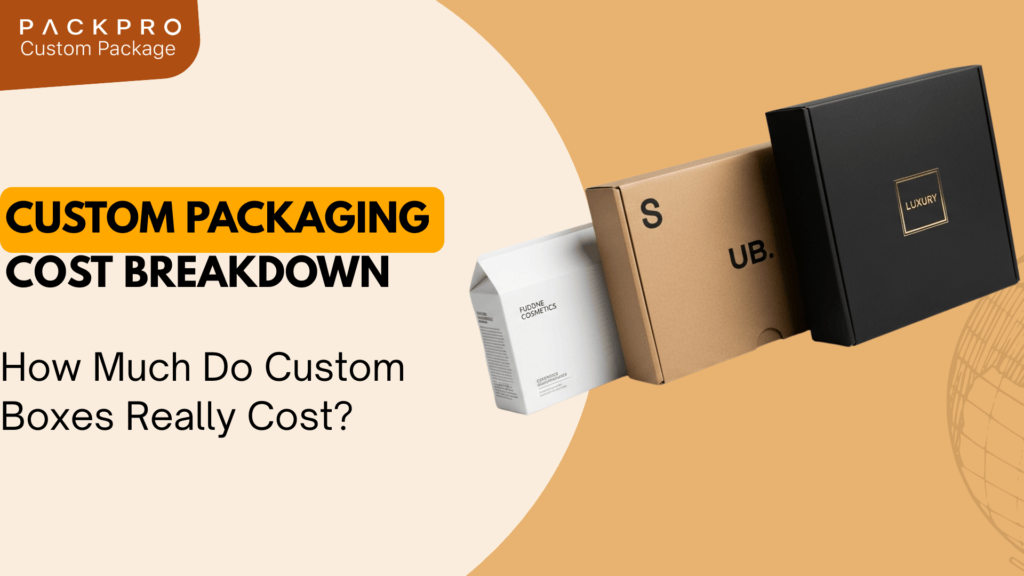
So, how much do custom boxes really cost? Expect to pay anywhere from $1 to over $25 per box. The final custom packaging cost depends on several key factors. Material choice is the biggest driver. Box style and structural complexity add to it. Print method and coverage levels determine printing cost. Finishing techniques like foil stamping or soft touch add premium. Order quantity is the most powerful lever — higher volumes reduce cost per unit significantly.
Quick answer: Custom box pricing typically ranges from $0.50 to $25+ per unit depending on material, structure, print complexity, finish, and order volume. Simple folding cartons at high volume cost under $1 per unit. Luxury rigid boxes with premium finishes range from $3 to $15 or more per unit at standard volumes.
Material Cost: The Foundation of Box Pricing
Material is the largest single component of custom packaging cost. Corrugated cardboard for shipping boxes is the least expensive option and typically costs between $0.50 and $2 per unit at standard volumes. Folding carton paperboard for retail packaging ranges from $0.50 to $3 per unit depending on board weight and print complexity. Rigid greyboard for luxury boxes ranges from $2 to $15 or more per unit depending on board thickness, wrap paper specification, and finishing.
Material cost per unit decreases as order volume increases because raw material is purchased in larger quantities and fixed setup costs are amortized across more units. A rigid box that costs $8 per unit at 500 pieces might cost $4 per unit at 2,000 pieces and $2.50 per unit at 10,000 pieces.
Print Method and Coverage
Digital printing is suitable for short runs and variable data applications. It carries no plate setup costs but has a higher cost per unit than offset printing. For runs below approximately 500 units, digital printing is often more economical overall despite the higher unit cost.
Offset printing requires plates that add a setup cost of $50 to $300 or more per colour depending on the format. Once setup is paid, the unit cost is lower than digital and decreases further as volume increases. For runs above 1,000 units, offset printing typically delivers better economics for standard packaging applications.
Print coverage also affects cost. Heavy coverage with multiple solid colours uses more ink and may require additional passes through the press, adding to production cost. Simpler colour schemes with limited coverage are less expensive to print.
Finishing: Where Premium Meets Cost
Finishing techniques add significant cost but also significant perceived value. Matte or gloss lamination adds $0.10 to $0.50 per unit depending on format and volume. Soft-touch coating adds a similar premium with a more distinctive tactile result. Foil stamping adds $0.20 to $1 or more per unit depending on foil area and complexity. Embossing or debossing adds $0.15 to $0.60 per unit. Spot UV coating over a matte base adds visual sophistication at a similar cost range.
The cumulative effect of multiple finishing techniques can double or triple the base material and print cost. Brands should specify finishing techniques selectively and verify that each element contributes meaningfully to brand perception at the intended retail price point.
Structure and Tooling
Standard box structures including straight tuck end cartons and regular slotted corrugated boxes use existing dies and carry no additional tooling cost. Custom structural shapes, window cutouts, special closures, and non-standard formats require custom die-cutting tools. Tooling costs typically range from $100 to $500 depending on complexity and are a one-time investment paid on the first order.
For rigid boxes, no tooling is required as the structure is cut and assembled without a die. However, the labour-intensive hand assembly process contributes to higher base unit costs compared to folding cartons.
Getting an Accurate Quote
The most accurate way to understand your packaging cost is to provide a complete specification including confirmed product dimensions, material preference, print colour count, finish requirements, and required quantity. A quote based on complete specifications is far more reliable than an estimate based on general descriptions.
Requesting quotes from two or three qualified suppliers allows for genuine price comparison on an equivalent specification basis. Quotes that appear significantly cheaper than others without explanation should be investigated to understand whether material, quality, or service assumptions differ.