
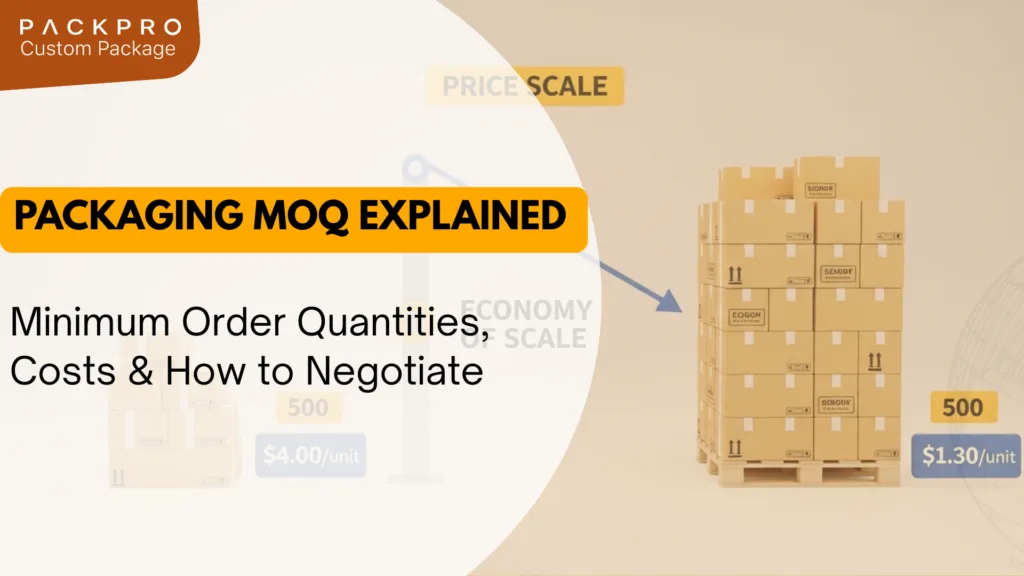
Minimum Order Quantity (MOQ) in packaging is the smallest number of units a packaging manufacturer is willing to produce in a single production run. MOQs exist because packaging production involves fixed costs, including plate setup, tooling, material preparation, and machine configuration, that must be distributed across the order quantity to achieve viable unit economics for the manufacturer.
Quick answer: Packaging MOQs typically range from 100 to 10,000 units depending on the packaging type, production method, and supplier. Digital printing enables lower MOQs than offset printing. Rigid boxes have higher MOQs than folding cartons due to hand assembly requirements. MOQs can often be negotiated with the right approach and relationship.
Why MOQs Exist in Packaging Manufacturing
Every packaging production run involves fixed costs that do not change regardless of the quantity produced. For folding cartons using offset printing, these include printing plate setup, die-cutting tool preparation, press makeready, and material preparation. For rigid boxes, they include material cutting setup and quality control calibration. These fixed costs must be recovered across the units in the order, which means smaller orders have higher per-unit costs and create lower returns for the manufacturer.
MOQs are set at the point where fixed cost recovery produces an acceptable return for the manufacturer at their standard pricing. Orders below the MOQ are either declined or priced at a significant premium to compensate for the lower volume efficiency.
Typical MOQ Ranges by Packaging Type
Folding cartons using offset printing typically have MOQs of 1,000 to 5,000 units. Digital printing for folding cartons can achieve MOQs as low as 50 to 250 units, with higher per-unit cost but no setup charges.
Corrugated shipping boxes using offset or flexographic printing typically have MOQs of 500 to 2,000 units. Digital corrugated printing enables lower MOQs similar to folding carton digital ranges.
Luxury rigid boxes typically have MOQs of 200 to 1,000 units due to the higher hand-assembly labour content, which creates less rigid MOQ boundaries than automated processes. Suppliers with premium pricing tiers may accept smaller quantities for appropriate per-unit cost levels.
How Print Method Affects MOQ
Print method is the most significant determinant of MOQ. Offset printing requires physical printing plates that cost between $50 and $300 or more per colour to produce. These plates are economical only when distributed across sufficient quantity. For a four-colour job with $800 in plate costs, a 500-unit run carries $1.60 per unit in plate cost alone, while a 5,000-unit run carries $0.16 per unit.
Digital printing eliminates plate costs entirely. The MOQ for digital packaging printing is therefore set by the minimum machine run time and handling cost rather than material setup investment. This makes digital printing significantly more accessible for brands ordering at lower volumes or needing rapid design iteration.
Negotiating Lower MOQs
MOQs are often negotiable, particularly with manufacturers who value building long-term supplier relationships. Effective negotiation approaches include accepting a higher per-unit cost to compensate for lower volume efficiency, committing to future larger orders in exchange for a lower initial run, agreeing to use standard sizes and structures that minimize setup costs, or paying setup costs separately at a fixed amount rather than amortizing them into unit price. For gift packaging specifically, see how to order custom magnetic gift boxes in small runs.
Brands with a clear growth trajectory and the ability to demonstrate committed future volumes are in a stronger position to negotiate initial low MOQ runs than brands making a single speculative order without any commitment beyond the immediate quantity.
MOQ Cost Implications
The unit cost at MOQ is typically significantly higher than the unit cost at higher volumes. Brands must evaluate whether the MOQ unit cost is viable for their product pricing structure, or whether they need to either accept a higher initial order quantity for better economics or find a supplier with lower MOQs at an acceptable quality level.
The financial risk of over-ordering to achieve better unit economics should be weighed against the risk of over-specifying and being left with excess packaging inventory if designs or product ranges change before the stock is consumed.
Have More Procurement Questions?
See our Procurement FAQ page for quick answers on MOQ, lead times, sampling, quality inspection, and export shipping — all in one place.