
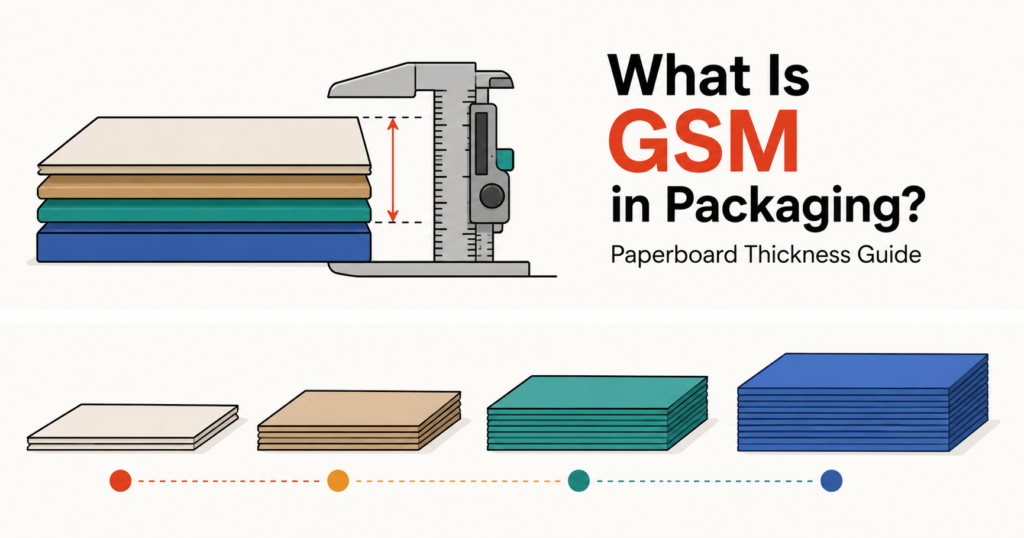
GSM shows up in almost every packaging quote, but a lot of first-time buyers nod along without really knowing what number they should ask for. It’s not a minor spec — it’s the difference between a box that feels premium in the hand and one that dents the moment it’s shipped.
Here’s what GSM actually measures, how it converts to the “point” system US factories often quote, and what range makes sense for the box you’re building.
What GSM Actually Means
GSM stands for grams per square meter — literally, how much a one-meter-by-one-meter sheet of the material weighs. It’s a weight measurement, not a thickness measurement, but for paperboard the two move together closely enough that GSM is used as a stand-in for “how sturdy does this feel.” Higher GSM generally means thicker, stiffer, more rigid material.
US suppliers sometimes quote in points (pt) instead, where 1 point equals 0.001 inch of caliper thickness. As a rough conversion, divide GSM by 25 to estimate points — 300 GSM is roughly 12 pt.
GSM to Points to Millimeters
| GSM | Points (pt) | Approx. mm |
|---|---|---|
| 250 | 10 pt | 0.25 mm |
| 300 | 12 pt | 0.30 mm |
| 350 | 14 pt | 0.36 mm |
| 400 | 16 pt | 0.41 mm |
| 450 | 18 pt | 0.46 mm |
| 500 | 20 pt | 0.51 mm |
| 600 | 24 pt | 0.61 mm |
These figures are for standard SBS (solid bleached sulfate) paperboard — the material behind most folding cartons and rigid boxes. Corrugated board works differently and is measured by flute type instead, covered below.
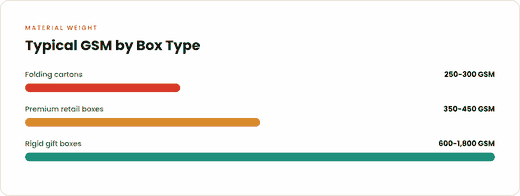
Typical GSM by Box Type
| Box Type | Typical GSM | Feel |
|---|---|---|
| Folding cartons & mailers | 250–300 GSM | Light, foldable, standard retail |
| Premium retail boxes | 350–450 GSM | Firm, holds shape without support |
| Rigid gift & luxury boxes | 600–1,800 GSM chipboard | Stiff, doesn’t flex, high-end feel |
| Corrugated shipping boxes | Measured by flute, not GSM | Cushioned, built for transit |
Corrugated Flutes: The Other Thickness System
Corrugated shipping boxes use a fluted (wavy) inner layer for cushioning, so they’re specified by flute type rather than GSM. The letter refers to the flute size, not the order it was invented in.
- E-flute (~1.5 mm) — thin, smooth surface for printing, common on small retail cartons and subscription boxes.
- B-flute (~3 mm) — the standard for e-commerce mailers and shipping boxes; good balance of cushioning and stack strength.
- C-flute (~4 mm) — the most common shipping-carton flute worldwide; strong crush resistance for heavier or bulkier products.
How to Choose the Right GSM
- Match it to the job, not your instinct — a heavier GSM isn’t automatically “better.” A 600 GSM folding carton wastes money and won’t fold cleanly; a 250 GSM rigid box won’t hold its shape.
- Factor in product weight — heavier or sharper-edged products need higher GSM or a rigid structure to avoid bulging or puncturing during transit.
- Ask for the exact number, not a description — “sturdy” and “premium” mean different things to different factories. Specify the GSM or point value directly in your spec sheet.
- Request a sample at your target GSM — thickness is one of the things a pre-production sample is for; you can feel the difference between 300 and 400 GSM in seconds, which is hard to judge from a spec sheet alone.
Frequently Asked Questions
What GSM is best for a standard retail box? Most standard folding cartons and product boxes use 300–350 GSM — enough structure to hold shape without adding unnecessary cost or weight.
Is higher GSM always better quality? No. GSM should match the product and box style — a heavier GSM than needed just adds cost and shipping weight without improving function.
Why do US and Chinese factories quote thickness differently? Chinese and most international factories use GSM (metric, weight-based); US factories often use points (imperial, caliper-based). Both describe the same material — converting between them avoids confusion when comparing quotes.
Can I mix GSM within one order, like a heavier lid and lighter base? Yes — this is common on two-piece rigid boxes, where the outer shell uses a heavier chipboard and the inner wrap paper is lighter. Specify each component’s GSM separately on your spec sheet.
Get the Right Material Spec for Your Box
PackPro’s team helps match GSM and material to your product before production starts, and every order ships a physical sample so you can feel the thickness for yourself. Request a free quote today — we respond within 24 hours.
Get a Free Quote → packpropkg.com/contact
Related Guides
- Packaging samples — How to Get Packaging Samples Before a Bulk Order (Step-by-Step)
- Pricing breakdown — How Much Does Custom Packaging Cost? 2026 Pricing Guide
- US e-commerce brands — How US E-commerce Brands Get Custom Boxes from China with Low MOQ