
Packaging lead time is the total duration from the moment you place a confirmed order with a manufacturer to the moment the goods arrive at your warehouse. For most custom packaging projects, the total timeline ranges from 3 to 8 weeks for production, plus 2 to 6 weeks for shipping, depending on freight methods and origin.
This timeline is not static. It fluctuates based on packaging complexity (e.g., rigid boxes vs. corrugated mailers), order volume, material availability, and seasonality. Understanding these variables is critical for procurement managers and brand owners to prevent stockouts before a product launch. Below, we break down every phase of the packaging manufacturing timeline, typical delays, and how to plan your inventory effectively.
The Components of Packaging Lead Time
When a custom box manufacturer quotes a lead time, they often refer strictly to production time—the time it takes to print, cut, glue, and pack the boxes. However, for a business planning a product launch, “lead time” must include the entire lifecycle.
A realistic packaging order planning schedule includes four distinct phases:
1. Structural Design and Sampling (1–2 Weeks)
Before mass production begins, the structural integrity and print quality must be verified.
- Dieline Creation: Engineers create a 2D flat layout of your box.
- Digital Proofing: A PDF check for artwork alignment and spelling.
- Physical Sampling: A prototype is cut and shipped to you. This is the biggest bottleneck; if the sample isn’t approved immediately, production cannot start.
2. Material Sourcing and Preparation (1 Week)
Once you approve the sample and pay the deposit, the factory orders the raw paperboard or corrugated stock. For standard materials, this is fast. For specialty papers (like textured or pearlized stock), sourcing can add 5–10 days to the custom packaging production time.
3. Mass Production (3–6 Weeks)
This is the core manufacturing phase. It involves:
- Printing: Offset or digital printing of the sheets.
- Finishing: Application of lamination, foil stamping, spot UV, or embossing.
- Die-Cutting: Cutting the sheets into the box shape.
- Gluing and Assembly: Folding cartons are machine-glued; rigid boxes often require manual assembly.
4. Shipping and Logistics (1–6 Weeks)
This is the most variable phase. Domestic shipping takes days; international shipping takes weeks. Packaging shipping timeline planning is essential here, as customs clearance can add unpredictable delays.
Typical Lead Times by Packaging Type
Not all boxes are created equal. The complexity of the structure directly dictates the box production lead time.
Folding Cartons (Cosmetic & Retail Boxes)
Typical Production Time: 10–15 Days
Folding cartons are the fastest to produce because the process is highly automated. High-speed offset presses print the sheets, and automated folder-gluer machines finish them rapidly.
- Best for: High-volume retail products, supplements, cosmetics.
- Delay Risk: Complex finishes like cold foil or soft-touch lamination require extra machine passes, adding 2–3 days.
Corrugated Mailer Boxes
Typical Production Time: 12–18 Days
While corrugated board is readily available, the process involves laminating a printed top sheet onto the corrugated flute (litho-lamination). The drying time for the glue and the die-cutting of thicker materials adds slightly to the timeline compared to folding cartons.
- Best for: E-commerce subscription boxes, shipping heavy items.
- Delay Risk: High moisture content in the air (common in humid manufacturing regions) can delay glue drying.
Rigid Boxes (Luxury Setup Boxes)
Typical Production Time: 20–35 Days
Rigid boxes (like iPhone boxes) have the longest packaging manufacturing timeline. This is because they require a “wrapping” process where paper is glued over a heavy chipboard structure. While machinery assists this, much of the precise wrapping and quality control is done by hand or semi-automated lines.
- Best for: Luxury goods, electronics, jewelry, PR kits.
- Delay Risk: Manual labor requirements mean these lines fill up fast during peak seasons.
Custom Inserts and Accessories
Typical Production Time: Runs concurrent with boxes
If your packaging requires custom foam, molded pulp, or thermoformed plastic trays, these must be produced simultaneously. Molded pulp, in particular, requires creating a metal mold (tooling), which can take 10–14 days before production even begins.
Key Factors That Influence Production Timelines
As an experienced manufacturer, we see consistent patterns in what causes timelines to extend.
The Impact of MOQ (Minimum Order Quantity)
High volume does not always mean a longer lead time per unit, but it does extend the total days on the press.
- Low MOQ (500–1,000 units): Often batched with other jobs or run on digital presses. Faster setup, but lower priority in queue. [Internal Link: Understanding MOQ and How it Affects Cost]
- High MOQ (50,000+ units): Requires longer press runs. However, high-volume orders often get priority scheduling.
Printing Methods: Digital vs. Offset
- Digital Printing: Zero setup time. Production can start immediately after file upload. Best for rush orders and short runs.
- Offset Printing: Requires making printing plates (CTP) and lengthy machine setup. Slower to start, but faster per unit once running.
Peak Season Congestion
If you are manufacturing in Asia, the packaging supplier China lead time is heavily dictated by the holiday calendar.
- Q4 Rush (Sept–Nov): Factories operate at 120% capacity preparing for Black Friday and Christmas. Lead times often double.
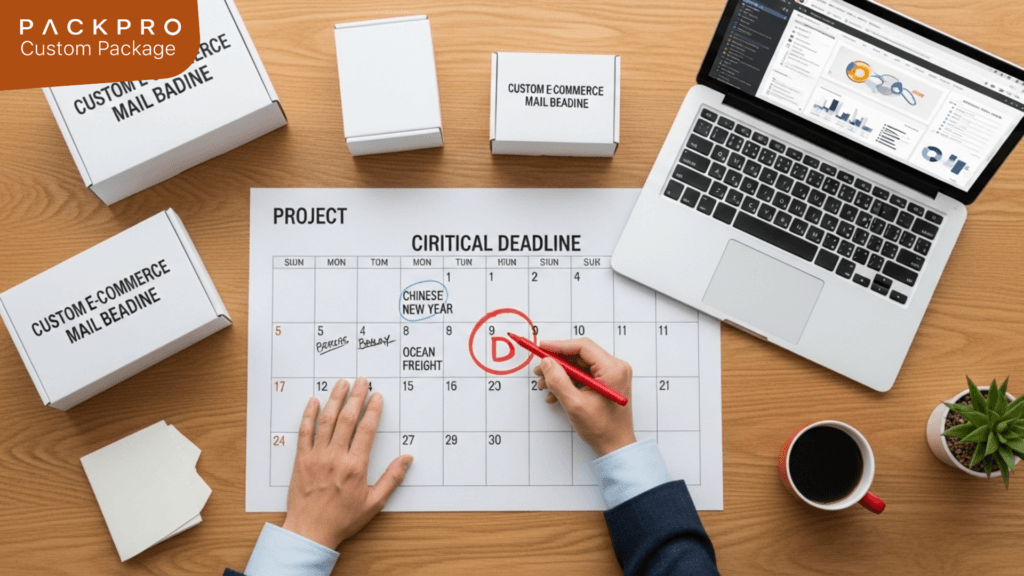
- Chinese New Year (Jan/Feb): Factories close for 2–4 weeks. Production stops completely. Orders must be placed 4–6 weeks before the holiday to ship on time.
“Chinese New Year”To provide authoritative context on why factories close and the significance of the holiday, which is a major factor in delays.
The Logistics Factor: Air vs. Sea Freight
Your packaging lead time calculation is incomplete without logistics.
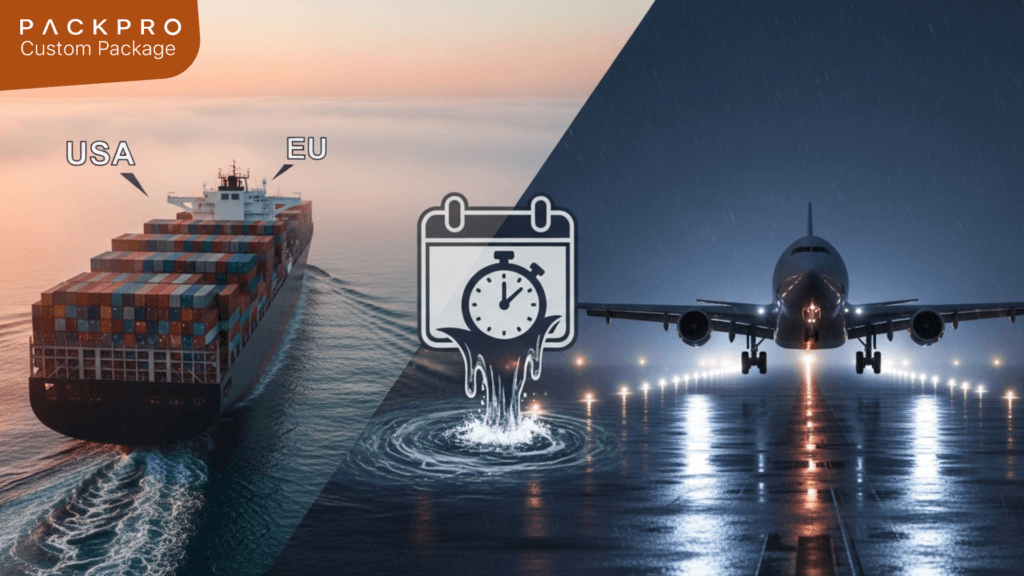
- Sea Freight (Ocean): 25–45 Days. The standard for bulk packaging. It is cost-effective but slow. Port congestion in Long Beach or Rotterdam can add 7+ days.
- Air Freight: 5–10 Days. Extremely fast but prohibitively expensive for bulky items like rigid boxes. Usually reserved for “emergency stock” to tide you over until the sea shipment arrives.
- LCL vs. FCL: Less-than-Container Load (LCL) takes longer than Full Container Load (FCL) because goods must be consolidated and deconsolidated at the ports.
An official logistics site (e.g., Maersk or FedEx) To back up claims about shipping times (Sea vs. Air) and potential port congestion issues.
Comprehensive Packaging Timeline Breakdown
Use this framework to plan your procurement cycle.
| Stage | Estimated Time | What Happens | Risk Factors & Delays |
| 1. Design & Quote | 2–5 Days | You submit specs; manufacturer provides pricing. | Vague requirements (size, material) cause back-and-forth emails. |
| 2. Sampling | 7–14 Days | Prototyping and physical approval of the box. | Revisions! Changing the size by 1mm requires a new sample. |
| 3. Order & Deposit | 2–3 Days | Contract signing and deposit payment. | International wire transfers can take 3 days to clear. |
| 4. Material Prep | 5–10 Days | Paper and board are purchased and cut to size. | Paper shortages or custom-colored paper requirements. |
| 5. Printing & Finish | 5–10 Days | Printing, foiling, lamination, and drying. | Color matching issues; humid weather affecting ink drying. |
| 6. Die-Cutting & Glue | 5–10 Days | Cutting shape, folding, gluing, and packing. | Glue failure checks; manual assembly bottlenecks. |
| 7. Quality Control | 2–3 Days | Final random inspection before packing. | Finding defects that require re-work or re-printing. |
| 8. Export Logistics | 3–5 Days | Trucking to port and customs clearance. | Random customs inspections or missing paperwork. |
| 9. International Freight | 25–40 Days | Ocean transit to destination port. | Storms, port strikes, or vessel overbooking (rolled cargo). |
How to Reduce Packaging Lead Time
If you are running behind schedule, there are strategies to accelerate the process.
1. Split Your Shipment
Don’t wait for the full 10,000 units to arrive by sea. Ask your manufacturer to ship 10% (e.g., 1,000 units) via air freight immediately upon completion. This gets you stock on shelves in 5 days while the rest travel cheaply by ocean.
2. Use Standard Materials
Custom-dyed paper or exotic textures require special ordering. Using standard “house stocks” (like standard C1S ivory board or Kraft corrugated) allows production to start immediately. [Internal Link: How to Choose the Right Material to Control Costs]
3. Approve Digital Proofs Only
For re-orders or simple designs, skip the physical sampling stage. Approving a digital PDF proof can shave 10–14 days off your packaging lead time. Note: Only recommended if you are confident in the structural fit.
4. Forecast and Blanket Orders
The ultimate pro-move. Place a “blanket order” for your annual volume (e.g., 50,000 units) but ask the factory to deliver in batches of 10,000 every quarter. The factory can produce materials in advance, drastically cutting lead time for subsequent deliveries.
Common Planning Mistakes That Cause Delays
As a custom box manufacturer, we often see delays that are entirely preventable.
- Waiting Until the Product is Finished: Never wait until your product is in your warehouse to order packaging. Packaging takes longer than most product manufacturing. Start the packaging design while your product is being prototyped.
- Incomplete Artwork Files: If your designer forgets “bleed” areas or outlines for fonts, the prepress team has to reject the file. This ping-pong game can waste a week.
- Ignoring Chinese Holidays: Every year, businesses are shocked when factories shut down for Chinese New Year. Manufacturing in China – The Essential Guide
Last-Minute Changes: Changing the box structure after the die-cut mold has been made requires new tooling (costing money) and restarts the clock (costing time).
Frequently Asked Questions About Packaging Lead Time
Need Reliable Packaging with Predictable Lead Times?
Missing a product launch date due to packaging delays is a nightmare scenario for any brand. You need a partner who values transparency as much as print quality.
At Pack Pro PKG, we specialize in high-stakes packaging order planning. We provide realistic timelines, proactive updates during production, and flexible logistics solutions to ensure your boxes arrive exactly when you need them.
Whether you need a complex rigid box or a high-volume folding carton run, our team manages the schedule so you can manage your brand.