
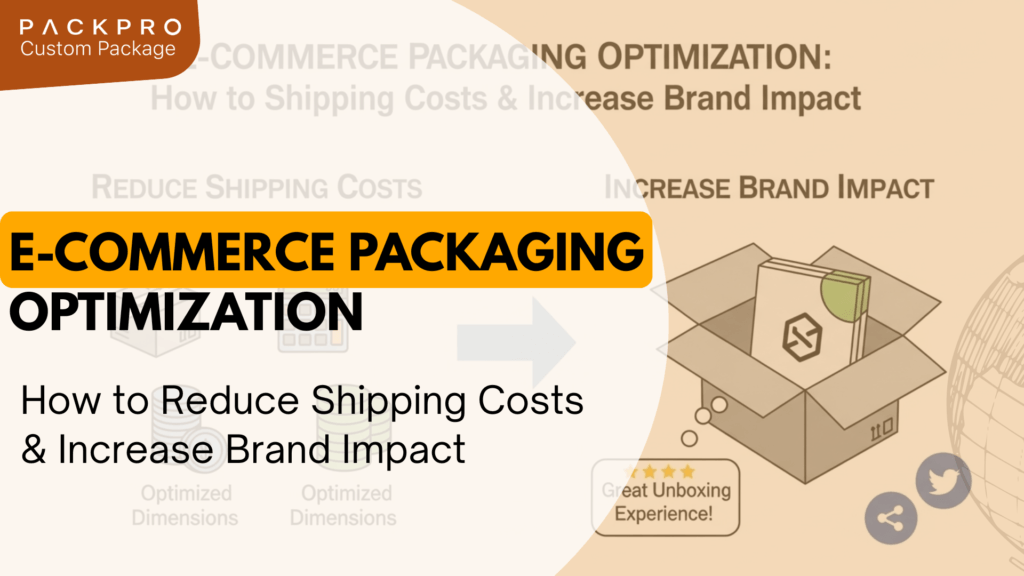
For modern brands, the shipping box is no longer just a container; it is the primary physical touchpoint between your business and your customer. In a competitive global market, e-commerce packaging must balance three competing demands: protecting the product, reducing shipping costs, and creating a brand experience worth talking about.
Quick answer: E-commerce packaging optimization means right-sizing boxes to eliminate dimensional weight charges, choosing materials that protect without excess weight, standardizing packaging formats across your product range, and designing interiors that create a memorable unboxing experience without adding significant cost.
Why E-commerce Packaging Cost Control Matters More Than Ever
Shipping carriers charge based on the greater of actual weight or dimensional weight (DIM weight). DIM weight is calculated from box volume, meaning oversized boxes cost more to ship regardless of what is inside them. For brands shipping high volumes, even a small reduction in box dimensions can produce significant cumulative savings across thousands of shipments annually.
Beyond dimensional weight, packaging weight itself directly affects shipping cost. Heavy corrugated boxes add to the billable weight of every shipment. Selecting lighter materials, eliminating unnecessary void fill, and right-sizing packaging are all levers that reduce per-shipment cost at scale.
Right-Sizing: The Most Impactful Single Change
The single most effective way to reduce e-commerce shipping costs is to eliminate empty space within packaging. Boxes that are significantly larger than the product they contain generate dimensional weight charges, require additional void fill material, and increase the risk of product movement and damage during transit.
Right-sizing means designing packaging to closely match the dimensions of the product range. For brands with multiple products, this often means developing two or three standardized box sizes that accommodate the full product range with minimal waste, rather than maintaining a large number of custom sizes that are each matched precisely to individual products.
The trade-off between perfect fit and operational simplicity is real. A large number of box sizes creates inventory management complexity and often increases per-unit cost due to lower quantities of each size. Finding the optimal balance requires analysing the full product dimension distribution and modelling shipping cost scenarios. Selling on Amazon? See how packaging changes lower FBA fees.
Material Selection for E-commerce Performance
Corrugated cardboard remains the dominant material for e-commerce shipping boxes because of its excellent strength-to-weight ratio, recyclability, and wide availability. Within corrugated materials, the choice of flute type, board grade, and liner quality all affect both the protective performance and the weight of the finished box.
Single-wall corrugated boxes are appropriate for most standard consumer goods applications. Double-wall constructions are required when shipping heavy, fragile, or high-value items. The appropriate specification should be determined by the weight and fragility of the product and the shipping conditions it will encounter, not by default selection of the heaviest option available.
Mailer boxes, which use a tuck-in lid rather than tape closure, have become popular for e-commerce brands because they eliminate the need for additional tape during packing, reduce assembly time, and create a cleaner opening experience for the customer. They are particularly well suited to products that do not require substantial void fill protection.
Reducing Void Fill Without Compromising Protection
Void fill adds weight, increases pack time, and adds material cost. Reducing reliance on loose void fill without compromising product protection is achieved primarily through better box sizing and interior structural design.
Custom inserts made from moulded pulp, corrugated dividers, or die-cut foam hold products in position without the need for loose fill. These inserts can be designed to precisely accommodate specific products, eliminating movement while reducing the total material used per shipment.
For brands with consistent product lines, investing in custom insert design often produces a positive return through reduced material cost, reduced pack time, improved product protection, and a significantly better customer experience compared to products arriving in a box filled with loose paper or air pillows.
Brand Impact Without Adding Cost
The assumption that branded e-commerce packaging must be expensive is incorrect. Brand impact in e-commerce packaging is primarily achieved through design consistency and print quality, not through complex finishing techniques or premium materials.
A well-designed mailer box with a clean, single-colour exterior print and a contrasting interior colour creates a strong brand impression at modest cost. The addition of a simple tissue wrap, a brand sticker or seal, and a printed insert card elevates the experience further without significant material cost.
The most cost-effective approach to branded e-commerce packaging is to identify two or three high-impact touchpoints within the shipment, such as the box exterior, the interior reveal moment, and the brand communication insert, and to invest in these deliberately while keeping other elements simple.
Standardization as a Long-Term Cost Strategy
Brands that standardize their packaging formats across their product range consistently achieve lower per-unit costs, faster packing operations, and simpler inventory management than brands that maintain a large variety of custom packaging formats.
Standardization does not mean generic. It means establishing a clear system of packaging sizes and formats that work across the product range, with consistent branding applied across all formats, and special packaging reserved for hero products or premium tiers where the additional cost is justified by commercial return.