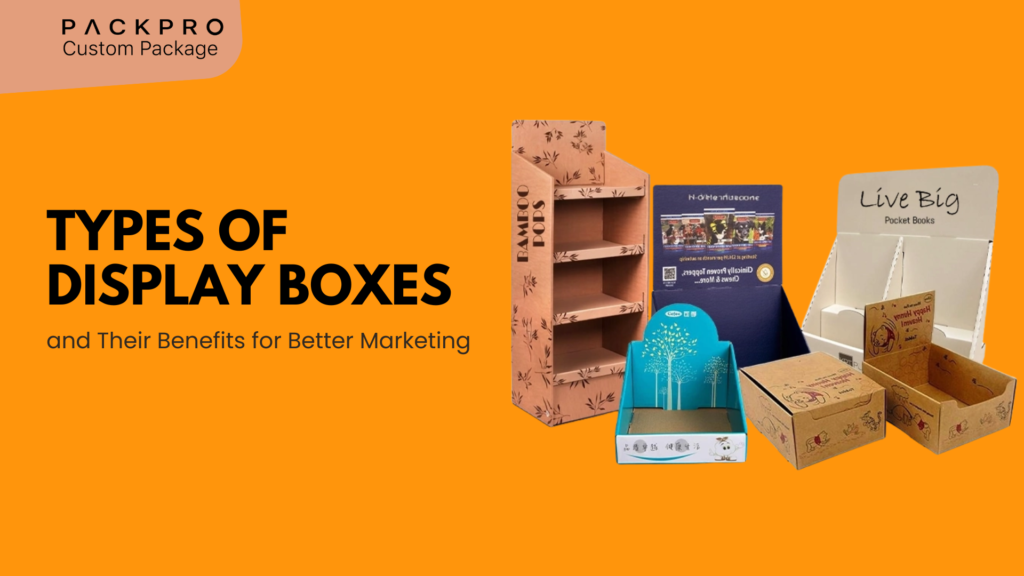
Types of Display Boxes and Their Benefits for Better Marketing

In retail, your packaging is your silent salesperson. Display boxes are one of the most powerful tools brands use to attract attention, organize products, and push sales — all without saying a word. But not all display boxes are created equal. Choosing the right type for your product can mean the difference between a customer picking it up or walking past it.

In this guide, we break down the most common types of display boxes, what makes each unique, and how to use them strategically for better marketing results.

What Are Display Boxes?

Display boxes are retail-ready packaging solutions designed to showcase products on shelves, countertops, or store floors. They serve a dual purpose: they protect the product while simultaneously acting as a branded display unit that draws the customer’s eye.

Unlike standard shipping boxes, display packaging is designed with visibility and engagement in mind — using open windows, bold graphics, and structural creativity to make products irresistible.

7 Main Types of Display Boxes

1. Counter Display Boxes

Counter display boxes sit on checkout counters or service desks. They’re compact, eye-catching, and strategically placed where customers are most likely to make impulse purchases.

Best for: Candy, lip balm, small electronics accessories, gift cards, and health supplements.

Marketing benefit: High visibility at the point of sale. Customers waiting in line naturally gravitate toward them.

2. Floor Display Boxes

These are freestanding units placed on the sales floor, often near entrances or high-traffic areas. They can hold multiple products and are usually taller than counter displays.

Best for: Beverages, snacks, seasonal products, toys, and promotional items.

Marketing benefit: Large surface area for bold branding and messaging. They command attention from across the store.

3. Window Display Boxes

Window boxes feature a clear cut-out or transparent panel that lets customers see the product inside without opening the packaging. The window can be die-cut in any shape — circular, oval, rectangular — to match the brand aesthetic.

Best for: Cosmetics, jewelry, cupcakes, candles, and artisan food products.

Marketing benefit: Transparency builds trust. Customers can verify quality before buying, which reduces hesitation.

Types of retail display boxes on a store shelf

4. Shelf-Ready Display Boxes (SRP)

Shelf-ready packaging is designed to be placed directly on the shelf without unpacking. The outer layer tears away to reveal the products neatly arranged and ready for sale.

Best for: Supermarket products, FMCG items, canned goods, and packaged snacks.

Marketing benefit: Saves time for store staff and ensures products are always neatly displayed. Great for large volume retail environments.

5. Hanging Display Boxes

These boxes include a hook or hole at the top to hang on pegboards or display racks. They’re extremely common in hardware stores, pharmacies, and convenience stores.

Best for: Batteries, small tools, hair accessories, cables, and travel-size products.

Marketing benefit: Maximizes vertical space. Products are easy to scan visually, and the header card (the visible top) offers prime branding real estate.

6. Tray Display Boxes

Tray displays are shallow, open-top boxes that hold multiple units side by side. They’re typically used with a lid that’s removed or slid back to reveal the product array.

Best for: Chocolates, cosmetics, branded merchandise, and gift sets.

Marketing benefit: Excellent for showcasing variety. The open format invites customers to browse and pick their favorite.

Tray display boxes and custom retail display packaging

7. Custom Retail Display Boxes

These are fully bespoke display solutions tailored to your product shape, brand identity, and retail environment. They can combine multiple features — windows, hooks, tiers, and custom print — into one cohesive unit.

Best for: Premium brands, product launches, trade shows, and luxury goods.

Marketing benefit: Maximum brand differentiation. A unique display box makes your product instantly recognizable and memorable.

Display Box Types at a Glance

TypePlacementBest ForKey Advantage
Counter DisplayCheckout counterSmall impulse itemsHigh point-of-sale visibility
Floor DisplaySales floorLarge/seasonal productsBold branding, high traffic
Window BoxShelf/counterPremium visual productsBuilds customer trust
Shelf-Ready (SRP)Retail shelfFMCG/bulk productsEasy stocking, neat display
Hanging DisplayPegboards/racksSmall packaged goodsVertical space efficiency
Tray DisplayCounter/shelfAssorted productsEncourages browsing
Custom DisplayAnywherePremium/launch productsFull brand differentiation

Key Benefits of Using Display Boxes for Marketing

  • Increased Impulse Purchases — Studies show that 60–70% of purchase decisions are made in-store. A well-placed display box triggers that decision.
  • Brand Reinforcement — Every surface of the display box is an opportunity to communicate your colors, logo, tagline, and story.
  • Better Product Organization — Display boxes keep products neat, upright, and easy to find — improving the shopping experience.
  • Cost-Effective Advertising — Unlike digital ads, display boxes work 24/7 inside the store — promoting your brand with zero ongoing cost.
  • Faster Retail Restocking — Shelf-ready formats save store staff time and reduce out-of-stock situations.
Display boxes boosting retail marketing and brand visibility

What to Consider When Choosing a Display Box

  • Product size and weight — Heavier products need sturdier structural designs
  • Retail environment — Counter space vs. floor space vs. hanging racks all require different solutions
  • Brand identity — The display should feel like a natural extension of your brand
  • Volume — How many units will the display need to hold at once?
  • Print and finish options — Matte, gloss, spot UV, foil stamping — all add different impressions

Final Thoughts

Display boxes are far more than packaging — they’re your in-store marketing team. Whether you need a simple counter display for a small product line or a fully custom floor display for a major launch, choosing the right type makes a measurable difference in sales and brand perception.

At PackPro, we design and manufacture custom display boxes for brands across every industry. From concept to final product, we help you create displays that don’t just hold your products — they sell them. Contact our team to get started today.

Frequently Asked Questions

What is the difference between a counter display box and a floor display box?

Counter display boxes are compact units designed to sit on checkout counters or service desks, targeting impulse purchases at the point of sale. Floor display boxes are freestanding, taller units placed in high-traffic areas of the sales floor, designed to hold more products and attract attention from a distance.

Which type of display box is best for increasing impulse purchases?

Counter display boxes are the most effective for triggering impulse purchases because they are positioned right at the checkout where customers are already waiting and making final decisions. Their compact, eye-level placement makes them nearly impossible to ignore during the transaction process.

What are shelf-ready display boxes (SRP) and how do they benefit retailers?

Shelf-ready packaging (SRP) is designed to be placed directly onto retail shelves without needing to unpack individual products — the outer layer simply tears away to reveal neatly arranged products. This saves significant time for store staff during restocking, reduces out-of-stock situations, and ensures a consistently neat shelf presentation that benefits both the retailer and the brand.

Can display boxes be fully customized to match my brand?

Yes — custom retail display boxes can be tailored to your exact product dimensions, brand colors, logo placement, and finish preferences. You can incorporate features like die-cut windows, hanging hooks, multi-tier shelving, and premium finishes such as matte lamination, gloss coating, spot UV, or foil stamping to create a display that is a true extension of your brand identity.

What materials are display boxes typically made from?

Most retail display boxes are made from SBS (Solid Bleached Sulfate) cardboard, corrugated board, or kraft paper, depending on the structural requirements and brand aesthetic. Corrugated board is used for floor displays that need to support heavier loads, while SBS cardboard is preferred for counter and shelf displays where print quality and visual appeal are the priority.