
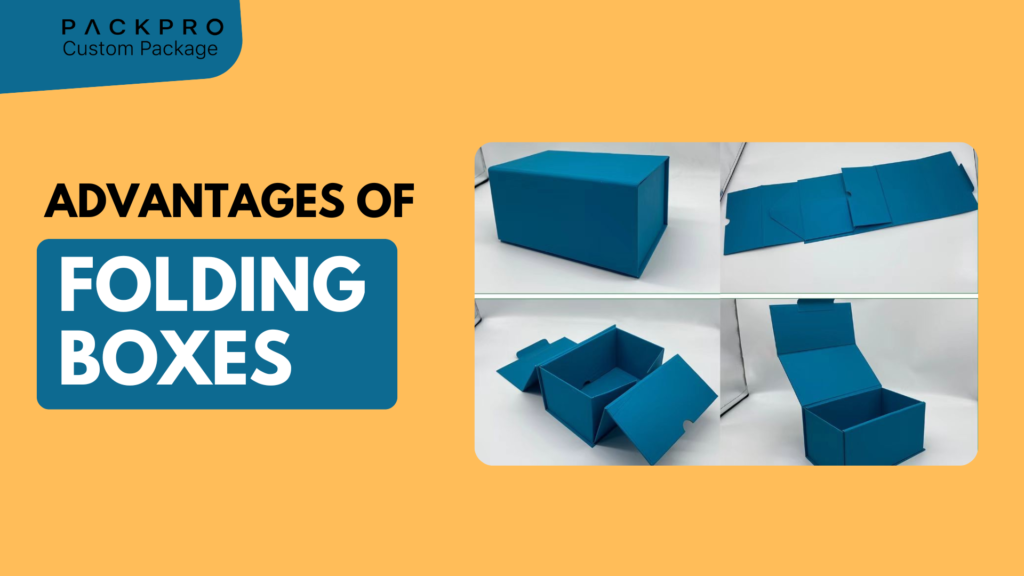
Advantages of Folding Boxes

Walk through any supermarket and pick up ten products at random. Chances are that seven or eight of them came in a folding box — also called a folding carton. It’s the packaging format that quietly runs the retail world: cereal, medicine, cosmetics, frozen food, electronics accessories, confectionery. The folding box does all of it.

Yet despite being everywhere, folding boxes are often underestimated. People associate them with “basic” packaging — but that misses the point. Folding boxes have a remarkable set of advantages that make them the right choice for a huge range of products and businesses. This guide breaks down exactly what those advantages are.

What Is a Folding Box?

A folding box (or folding carton) is a packaging structure made from a single flat sheet of paperboard that is scored and creased so it can be folded into a three-dimensional box. It ships and stores flat, and is assembled — either by hand or machine — just before it’s filled with product.

Folding boxes are made from paperboard (also called cartonboard or chipboard) in various grades and thicknesses. The key characteristics are that they are pre-printed, pre-cut, and pre-creased — making them ready to assemble and fill on a production line or by hand.

Advantage 1 — Space-Efficient Storage and Shipping

One of the most practical advantages of folding boxes is that they ship and store flat. Before assembly, a pallet of flat folding cartons takes up a fraction of the space that the same number of pre-erected boxes would require.

For businesses, this means lower storage costs, lower inbound freight costs for the empty packaging, and the flexibility to hold larger quantities of packaging stock without needing additional warehouse space. This is especially valuable for businesses with limited storage or those that order packaging in large volumes.

Advantage 2 — Lightweight and Low Packaging Weight

Folding cartons are made from thin paperboard — they’re inherently lightweight. This keeps the overall packaged weight of the product low, which matters for shipping costs and for products where packaging weight is part of the spec (such as food products with net weight requirements).

Compared to rigid boxes, glass jars, or plastic containers, a folding carton adds minimal weight to the product. For e-commerce businesses where every gram affects shipping costs, this is a real commercial advantage.

Advantage 3 — Excellent Printability for Branding

Folding boxes are one of the best surfaces available for packaging print. Coated paperboard takes ink exceptionally well — colours are vibrant, fine details are crisp, and the full range of printing techniques (offset litho, flexo, digital, screen) can be applied.

This makes folding cartons ideal for brand-driven packaging. Every face of the box is a canvas: brand colours, product photography, ingredient information, barcodes, certifications, and marketing copy can all be incorporated into a single printed sheet before the box is even folded.

Premium finishing options — embossing, debossing, foil stamping, spot UV, soft-touch lamination — are all compatible with folding cartons, allowing even modest-sized businesses to create packaging that looks and feels premium.

Custom printed folding boxes with vibrant branding and premium finishing options

Advantage 4 — Cost-Effective at Both Small and Large Volumes

Folding cartons are competitively priced at most volume levels. For large production runs, the unit cost is very low — the tooling costs are amortised quickly, and the manufacturing process (printing, die-cutting, creasing, gluing) is highly automated.

For smaller runs, digital printing has made short-run folding cartons increasingly accessible. Small businesses and brands testing new products no longer need to commit to tens of thousands of units to get professionally printed folding boxes at a reasonable cost.

Advantage 5 — Versatile in Structure and Style

Folding boxes come in a wide variety of structural styles, each suited to different products and applications:

  • Tuck-end boxes — straight or reverse tuck, the most common style for retail products
  • Auto-bottom (crash-lock) boxes — base locks into place automatically, ideal for heavy products
  • Sleeve boxes — a sleeve that slides over a tray, common in cosmetics and food
  • Gable-top boxes — a roof-shaped top with a handle, used for food and gifts
  • Window cartons — a clear plastic window cut into the box to show the product inside
  • Pillow boxes — a curved, pillow-shaped structure often used for small gifts
  • Snap-lock base boxes — base tabs lock together by hand for a secure closure

This structural versatility means a folding carton can be designed for almost any product geometry — from a slim lipstick to a bulky appliance accessory.

Advantage 6 — Compatible with High-Speed Automated Production

Folding cartons are designed to work with high-speed cartoning machines. In pharmaceutical, food, and FMCG manufacturing, automated cartoners erect, fill, and close thousands of folding boxes per hour. The consistency of the die-cut and crease lines means the machine can reliably process each box without jamming or misalignment.

For high-volume businesses, this compatibility with automation is a critical operational advantage — it keeps production lines running fast and labour costs low.

Folding boxes on high-speed automated production line in FMCG manufacturing

Advantage 7 — Recyclable and Environmentally Responsible

Paperboard is one of the most widely recycled packaging materials in the world. Folding cartons are accepted in household and commercial recycling streams virtually everywhere, making them an easy and credible sustainability choice for brands and consumers alike.

Many folding cartons are made from FSC-certified board (Forest Stewardship Council), which gives customers confidence that the fibre comes from responsibly managed forests. For brands with sustainability commitments, specifying FSC-certified folding cartons is a straightforward and verifiable action.

Compared to plastic packaging formats, folding cartons have a significantly lower environmental impact in terms of recyclability, biodegradability, and consumer perception.

Advantage 8 — Provides Essential Product Information Space

Every face of a folding box can carry information. For regulated products — food, pharmaceuticals, supplements, cosmetics — the box provides the required space for mandatory labelling: ingredients, allergens, dosage instructions, barcodes, certifications, country of origin, and legal text.

Unlike a pouch or a label on a bottle, a folding box provides multiple flat panels that are easy to print, read, and scan. For products with complex regulatory requirements, this information-carrying capacity is not just convenient — it’s essential.

Advantage 9 — Tamper Evidence and Product Security

Folding cartons can be designed with tamper-evident features to protect products from interference before purchase. Glued closing flaps, perforated tear strips, and shrink-wrapped overwraps are all compatible with folding carton structures. For pharmaceutical and food products, this tamper-evidence is often a regulatory requirement.

The closed nature of a folding carton also protects products from dust, light, and contamination — which matters for cosmetics, food items with light sensitivity, and pharmaceutical products.

Folding boxes with tamper-evident features for food, pharma and retail packaging

Advantage 10 — Enhances Shelf Presence and Retail Performance

In a retail environment, packaging is marketing. A well-designed folding carton stands upright on shelf, faces the customer squarely, and communicates the brand in an instant. The flat surfaces of a folding box are ideal for bold brand graphics that create visual impact at shelf level.

Studies consistently show that packaging design influences purchase decisions — and folding cartons, with their large printable surface area and structural consistency, give brands the best opportunity to influence that decision at the moment of purchase.

Industries Where Folding Boxes Excel

IndustryCommon Folding Box Applications
Food and beverageCereal boxes, frozen food cartons, confectionery, tea and coffee
PharmaceuticalsMedicine cartons, supplement boxes, medical device packaging
Cosmetics and beautyFoundation boxes, perfume cartons, skincare packaging
ElectronicsAccessory boxes, headphone packaging, charger cartons
Toys and gamesBoard game boxes, toy cartons, puzzle packaging
Gifts and retailGift boxes, display cartons, promotional packaging

Final Thoughts

Folding boxes are everywhere for a reason. They’re practical, affordable, customisable, and sustainable — a combination that’s hard to beat for most product categories. Whether you’re launching a new retail product, scaling a food brand, or packaging a pharmaceutical line, folding cartons offer the versatility and performance you need.

At PackPro, we manufacture custom folding boxes in any size, structure, and finish. Contact us to discuss your specifications and get a quote.

Frequently Asked Questions

What is a folding box (folding carton)?

A folding box, also called a folding carton, is a packaging structure made from a single flat sheet of paperboard that is pre-scored and creased so it folds into a three-dimensional box. It ships flat, is assembled just before filling, and is one of the most widely used packaging formats in food, pharmaceutical, cosmetics, and retail industries.

What are the main advantages of folding boxes?

Folding boxes offer ten key advantages: space-efficient flat storage, low packaging weight, excellent printability for branding, cost-effectiveness at any volume, structural versatility across styles (tuck-end, auto-bottom, sleeve, gable-top), compatibility with automated production lines, recyclability, mandatory labelling space, tamper-evidence options, and strong retail shelf presence. Together, these make them one of the most practical packaging formats available.

Are folding cartons recyclable?

Yes. Folding cartons are made from paperboard, one of the most widely recycled packaging materials in the world. They are accepted in household and commercial recycling streams in virtually every market. Many folding cartons are also made from FSC-certified board, giving brands a verifiable sustainability credential they can communicate to customers.

Which industries use folding carton packaging?

Folding cartons are used across almost every consumer-facing industry: food and beverage (cereal, frozen food, confectionery), pharmaceuticals (medicine and supplement cartons), cosmetics and beauty (skincare, perfume boxes), electronics (accessory packaging), toys and games, and retail gifting. Their versatility makes them suitable for any product that benefits from a printed, structured package.

Can folding boxes be custom printed with my brand design?

Yes. Folding cartons are one of the best surfaces available for packaging print — coated paperboard takes ink exceptionally well with vibrant colours and crisp details. Full CMYK printing, embossing, debossing, foil stamping, spot UV, and soft-touch lamination are all compatible with folding cartons, allowing businesses of any size to achieve a premium, branded result.