
For modern brands, the shipping box is no longer just a container; it is the primary physical touchpoint between your business and your customer. In a competitive global market, e-commerce packaging dictates logistics profitability, warehouse efficiency, and customer retention rates. Yet, many operations managers and procurement teams overlook the structural engineering required to balance protection with cost.
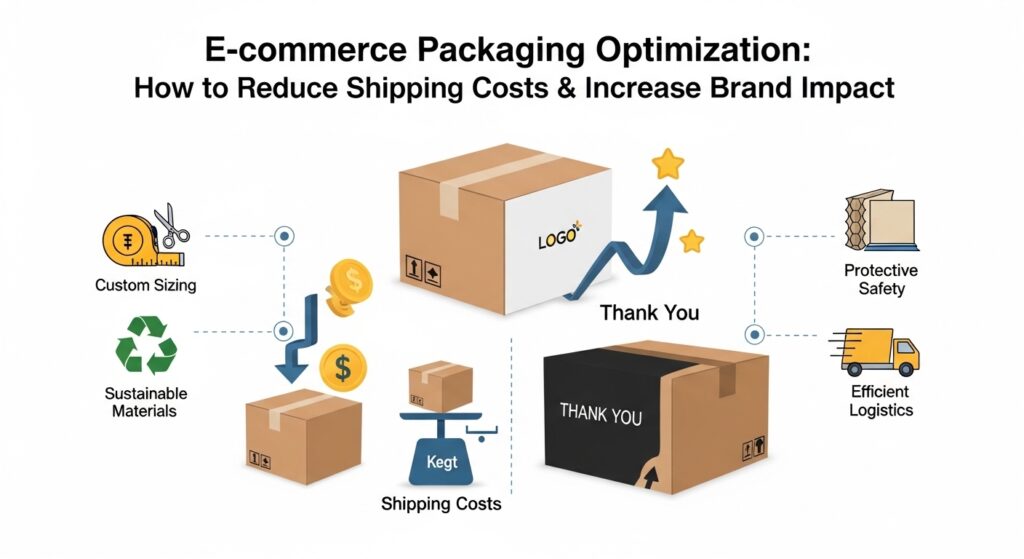
E-commerce packaging refers to the specialized design and manufacturing of shipping containers engineered to withstand the rigors of the logistics chain while minimizing dimensional weight and delivering a premium unboxing experience. Unlike retail packaging, it prioritizes durability, shipping efficiency, and direct-to-consumer engagement over shelf display appeal.
Optimizing your packaging strategy is not merely a design choice—it is a financial imperative. By re-engineering your supply chain materials, you can significantly reduce shipping costs, minimize product damage, and elevate your brand’s market position.
What Is E-commerce Packaging?
E-commerce packaging is a distinct category of industrial design focused on the safe and efficient transport of goods from a fulfillment center directly to the end consumer. Unlike traditional retail packaging, which fights for attention on a crowded store shelf, e-commerce solutions must fight for survival in the back of delivery trucks and automated sorting centers.
This category encompasses everything from the primary vessel (the box or mailer) to internal void fill, tissue paper, and inserts. For a custom packaging factory in China serving global markets, the goal is to create a vessel that is robust enough to survive cross-border shipping yet refined enough to delight a customer in New York or London.
Why Online Brands Need Different Packaging Than Retail Brands
Retail packaging is designed for static display. It often features window cutouts, lightweight folding carton materials, and dimensions maximizing shelf frontage. If you utilize retail packaging for e-commerce shipments without modification, you invite disaster.
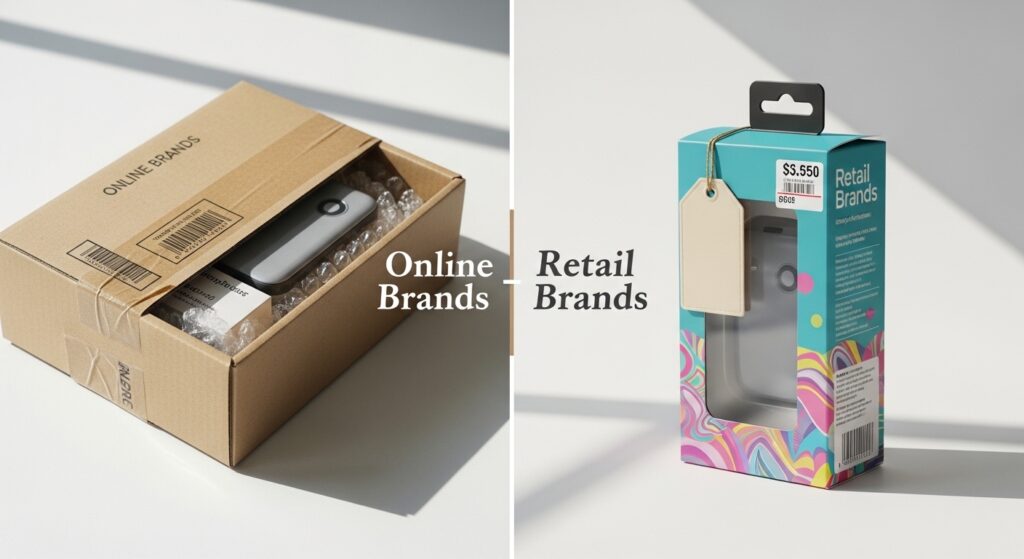
The e-commerce supply chain involves an average of 20+ touchpoints—loading, unloading, conveyor belts, and drop-offs. Retail boxes are not engineered for these impacts. Furthermore, retail boxes are rarely optimized for shipping volume. Sending a retail box inside a standard shipping carton often results in “shipping air,” where you pay for empty void space rather than product weight.
The True Cost of Shipping Air (Dimensional Weight Explained)
One of the most critical concepts for operations managers to master is Dimensional (DIM) Weight. Carriers like FedEx, UPS, and DHL do not charge solely based on the actual weight of the package. They charge based on the space the package occupies in their aircraft or truck.
If your e-commerce packaging is inefficiently sized, you are essentially paying premium rates to ship air.
The Formula:
Typically, DIM weight is calculated as $(Length \times Width \times Height) / Divisor$.
If the DIM weight exceeds the actual weight, the carrier charges the DIM weight. Structural optimization that shaves just 1-2 centimeters off your box dimensions can result in massive savings when extrapolated across 50,000+ units.
How to Reduce Shipping Costs Through Structural Optimization
To reduce shipping costs packaging, you must look beyond carrier negotiations and focus on the box engineering itself. This requires a partnership with a manufacturer that understands structural design.
Structural Engineering and Fit
Advanced structural engineering ensures the packaging fits the product snugly, eliminating the need for excessive void fill (bubble wrap or peanuts) which adds cost and labor time. By customizing the insert and box size to the product’s exact specifications, you reduce the overall exterior volume.
Material Grade Selection
Using the correct board grade prevents “over-specifying.” You do not always need a double-wall corrugated box for a lightweight garment. Conversely, under-specifying leads to returns. Finding the “Goldilocks” zone of material strength is key to cost control.
Collapsible Packaging vs Traditional Rigid Boxes
For luxury brands, rigid boxes (set-up boxes) are the standard for high-end presentation. However, they are a logistical nightmare. Rigid boxes ship fully assembled, meaning you are shipping mostly empty air from the manufacturer to your warehouse.
Collapsible packaging solutions are the strategic alternative.
Collapsible rigid boxes look and feel exactly like premium set-up boxes when assembled. They feature magnetic closures and high-quality finishing. However, they ship flat.
- freight Impact: You can fit up to 4x more collapsible boxes on a pallet compared to rigid boxes.
- Warehousing: They occupy significantly less space in your warehouse before fulfillment.
- Cost: While the unit cost might be slightly higher due to complex hand-assembly during manufacturing, the landed cost (Unit Price + Shipping) is often 30-40% lower.
Choosing the Right Material (Corrugated vs Paperboard vs Rigid)
Selecting the right substrate is a balancing act between protection, cost, and aesthetics.
- Corrugated Board: The backbone of e-commerce. Available in various flutes (E-flute is popular for high-end mailers; B-flute for shipping cartons). It offers excellent crush resistance.
- Folding Carton (Paperboard): Best for lightweight items or as a primary retail package inside a shipping box. It offers high print quality but low structural protection for shipping alone. See our guide on [Internal link: Folding Carton Box Styles].
- Rigid Board: Used for luxury goods. Provides the highest perceived value but requires careful structural engineering to ensure it survives the shipping network. For more on this, review our insights as a [Internal link: Custom Rigid Box Manufacturer].
Designing for Unboxing Experience & Brand Recall
In B2B and B2C markets alike, the unboxing experience is a marketing channel. When a customer opens a package, their dopamine levels spike.
Premium shipping boxes capitalize on this by utilizing:
- Interior Printing: Placing the branding inside the box creates a surprise reveal.
- Tactile Finishes: Soft-touch lamination, spot UV, or embossing adds a sensory layer to the experience.
- Smart Inserts: Custom inserts hold the product in place for presentation, ensuring the customer sees the product exactly as intended, not jumbled in the corner.
This attention to detail drives brand recall and user-generated content on social media.
Packaging Durability & Damage Reduction
The most expensive package is the one that arrives damaged. Replacement costs include the product, the shipping (both ways), the packaging, and the customer service labor—not to mention the loss of customer lifetime value.
We recommend ISTA (International Safe Transit Association) testing protocols for all e-commerce designs. This includes drop tests, vibration tests, and compression tests. A qualified manufacturer will have internal lab capabilities to simulate the shipping environment before mass production begins.
Sustainability in E-commerce Packaging
Sustainability is no longer optional; it is a procurement requirement for global brands. Operations managers must source materials that comply with international standards.
- FSC Certification: Ensure your paper comes from responsibly managed forests.
- Recyclability: Avoid mixed materials (like foil glued to plastic) that render the box unrecyclable.
- Right-sizing: The most sustainable action is reducing material usage through structural optimization.
For a deeper dive into eco-friendly options, read our [Internal link: Sustainable Luxury Packaging Guide].
Automation & Fulfillment Compatibility
High-growth brands eventually move toward automated fulfillment. Your packaging must be compatible with:
- Case Erectors: If you use automatic taping machines, your boxes must be perfectly square and consistent.
- Robotic Picking: Surfaces must be suitable for vacuum lifters.
- Barcode Readability: Print placement must align with scanner locations.
Common mistakes include designing complex folding sequences that slow down the packing line. Packaging should be intuitive and fast to assemble by fulfillment staff.
Why Global Brands Choose a Custom Packaging Factory in China
For brands scaling in the USA, UK, and Europe, partnering with a custom packaging factory in China remains the most strategic move for high-volume, high-complexity orders.
Capabilities of a Tier-1 Manufacturer:
- 20+ Years Experience: Deep knowledge of international export standards.
- 50,000+ Units Daily Capacity: Scalability for peak seasons (Q4).
- Advanced Structural Engineering: In-house teams that optimize dielines for cost and safety. See our [Internal link: Packaging Dieline Guide] for technical details.
- Hand-Assembly Specialists: China offers a skilled workforce for complex rigid and collapsible box assembly that is cost-prohibitive in Western markets.
- Certifications: ISO 9001 for quality management and FSC for sustainability.
Traditional Retail Packaging vs. Optimized E-commerce Packaging
The following table highlights the critical differences operations teams must recognize:
| Feature | Traditional Retail Packaging | Optimized E-commerce Packaging |
| Primary Goal | Designed for shelf display & theft prevention | Designed for shipping durability & unboxing |
| Structure | Fixed rigid structure or soft folding carton | Collapsible, E-flute mailer, or rigid-hybrid |
| Volume Efficiency | Higher dimensional weight (wasted space) | Space-optimized (lower DIM weight) |
| Durability Testing | Minimal drop testing required | ISTA-tested durability for logistics chains |
| Design Focus | Exterior aesthetics & window patching | Interior branding & secure closure mechanisms |
| Cost Driver | Printing finishes & foil stamping | Structural integrity & fulfillment speed |
How Packaging Impacts Customer Retention in E-commerce
Retention is the new acquisition. Your packaging strategy plays a pivotal role in customer lifetime value (CLV).
First Impression at Delivery
A beaten-up, generic brown box signals “utility.” A branded, pristine mailer signals “value.” This psychological anchor is set before the product is even touched.
Unboxing Psychology
The ritual of unboxing—peeling the strip, lifting the lid, parting the tissue paper—builds anticipation. This sensory experience increases the perceived value of the product inside.
Repeat Purchase Influence
Data suggests that premium packaging increases the likelihood of repeat purchases. Customers associate the quality of the packaging with the quality of the brand. If the box is premium, the brand is premium.
Social Media Sharing
“Instagrammable” packaging turns customers into micro-influencers. Unboxing videos are a massive category on TikTok and YouTube. Free organic reach is generated simply by designing a box worth filming. Consider using strategies found in our PR Box Packaging Guide.
Reduced Return Rates
When a product arrives perfectly intact and beautifully presented, “buyer’s remorse” is significantly reduced. Secure packaging also eliminates returns caused by shipping damage.
Logistics-Focused Considerations
For the logistics manager, the packaging strategy extends far beyond the box itself.
Dimensional Weight
As discussed, optimizing for DIM weight is the fastest way to improve margin. We continually review client dielines to shave millimeters that result in tier-drops for shipping zones.
Freight Optimization
For international brands, pallet efficiency is crucial. We calculate pallet patterns to maximize the number of units per container. Using collapsible packaging solutions allows you to ship up to 400% more units per 40ft High Cube container compared to rigid boxes.
International Export Considerations
Shipping from China to the USA or Europe requires durable export cartons (shippers). We utilize double-wall (BC flute) master cartons to protect the unit boxes during ocean freight.
Customs Compliance
Packaging must bear correct Country of Origin markings (“Made in China”) to avoid customs delays. We ensure all print files comply with import regulations for your target market.
Common E-commerce Packaging Mistakes That Increase Costs
Even experienced procurement teams fall into these traps:
- Oversized Boxes: Using a “one size fits all” box for varied SKUs leads to massive void fill costs and DIM weight penalties.
- Over-Packaging: Using excessive layers (polybag + box + bubble wrap + tissue + another box) frustrates customers and increases waste.
- Weak Structural Support: Ignoring grain direction in corrugated board can lead to box collapse under stacking pressure.
- Ignoring Automation: Designing boxes that take 60 seconds to fold manually creates a bottleneck in the warehouse.
- Using Retail Packaging for Shipping: Relying on thin folding cartons to survive the courier network without a master shipper.
Frequently Asked Questions (FAQ)
Conclusion
Optimizing your e-commerce packaging is a multi-faceted challenge that requires a balance of aesthetics, engineering, and logistics strategy. It is not enough to simply buy a box; you must engineer a solution.
With over 20 years of experience, a daily capacity exceeding 50,000 units, and a dedicated team of structural engineers, we are the partner of choice for global brands seeking to refine their supply chain. Our collapsible packaging solutions and ISO-certified processes ensure you get premium quality that withstands the journey from our factory in China to your customer’s doorstep.
Leverage our expertise to transform your packaging from a cost center into a competitive advantage.
Request an e-commerce packaging consultation to optimize your shipping efficiency and elevate your brand experience.
External resources referenced for authority:
- International Safe Transit Association (ISTA) – For global standards on package testing and validation.
- International Organization for Standardization (ISO) – For details on quality management systems (ISO 9001).
- Forest Stewardship Council (FSC) – For verification of sustainable forestry practices.