
Selecting the right folding carton box styles is a strategic decision that directly impacts your unit costs, assembly speed, product protection, and shelf presence. For global brands procurement teams, the choice isn’t just aesthetic—it’s structural engineering. The wrong style can lead to inflated shipping costs, damaged goods, or inefficient automated packing lines.
Folding carton box styles refer to the standardized structural designs of paperboard packaging, defined by their closure mechanisms, bottom construction, and assembly requirements. Common styles like Tuck End, Auto-Lock Bottom, and Snap Lock Bottom determine a package’s load-bearing capacity, assembly speed, and suitability for automation vs. manual packing.
This guide provides a technical deep dive into folding carton structures from the perspective of a premium manufacturing partner. We will analyze the most effective styles for retail and e-commerce to help you optimize your supply chain and elevate your brand presentation.
What Are Folding Carton Box Styles?
Folding cartons are the workhorse of the retail industry. Unlike rigid boxes, which are shipped fully assembled, folding cartons are shipped flat (knocked down flat or KDF) to minimize logistics costs. They are then assembled—either manually or via machine—at the fulfillment stage.
The “style” of a folding carton dictates how the paperboard is cut, creased, and glued. This structural blueprint defines the box’s integrity. A cosmetic brand requires a different structural style than a heavy electronics manufacturer. Understanding the nuance of these styles allows procurement managers to balance material usage with structural performance.
As a custom folding carton manufacturer, we see firsthand how a minor adjustment in flap structure or locking mechanism can save thousands of dollars in material waste and labor hours over a production run of 100,000 units.
Why Structural Design Matters in Paperboard Packaging
Before exploring specific styles, it is crucial to understand the engineering principles behind paperboard packaging box design. Structural design is not merely about holding a product; it is about surviving the supply chain.
The Impact of Grain Direction
The structural strength of a carton relies heavily on the grain direction of the paperboard. A skilled custom packaging factory in China will orient the grain to maximize vertical compression strength (stacking strength) or horizontal rigidity, depending on whether the box will be palletized or hung on a peg hook.
Caliper and Material Selection
The thickness (caliper) of the paperboard must match the box style. Complex styles with intricate locking tabs require a material that folds cleanly without cracking. Simple styles like sleeves can utilize lighter weights to reduce costs.
Automation Compatibility
High-volume brands often use cartoning machines. Certain styles, like Reverse Tuck Ends, are easier to automate than others. Choosing a style incompatible with your co-packer’s machinery can cause costly production bottlenecks.
Most Popular Types of Folding Cartons
Below is a detailed analysis of the most prevalent folding carton styles used by global brands in the USA, Europe, and Australia.
Tuck End Boxes (Straight Tuck End & Reverse Tuck End)
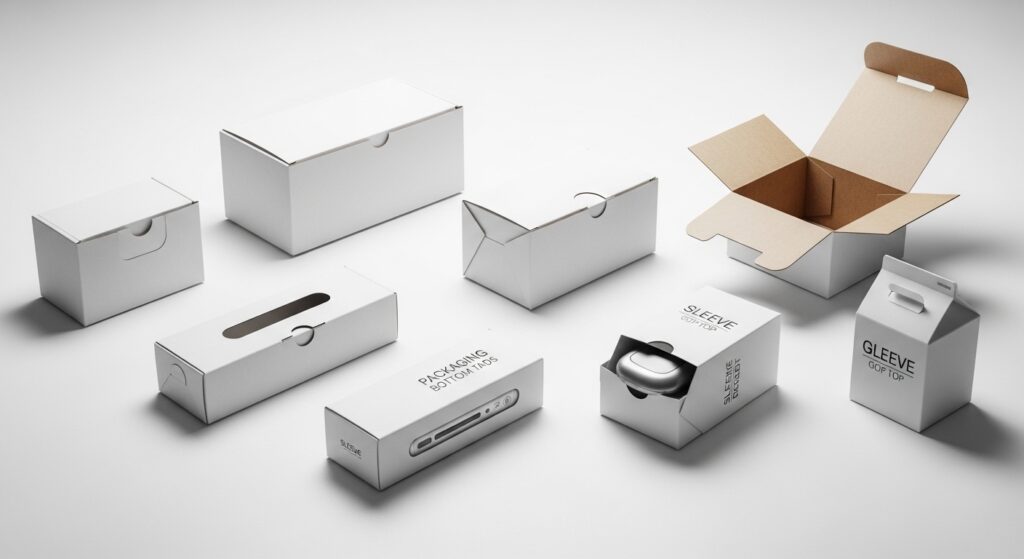
Tuck end boxes are the industry standard for lightweight retail products. They are versatile, material-efficient, and offer a clean presentation.
1. Straight Tuck End (STE)
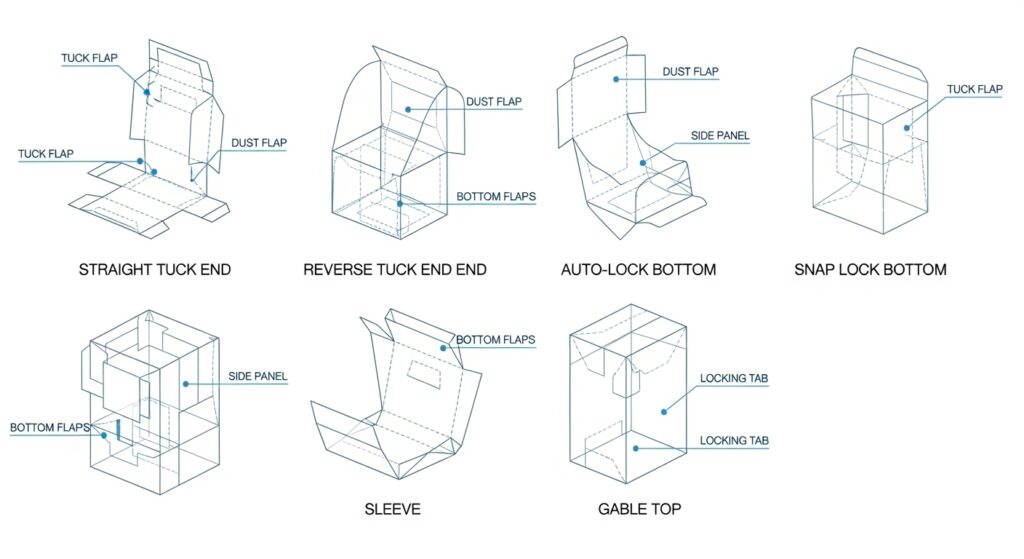
- Structure: Both the top and bottom closure panels tuck from the front to the back (or back to front). This creates a seamless front panel without raw edges, ideal for premium branding.
- Best Use Cases: High-end cosmetics, perfume bottles, premium confectionery.
- Retail vs E-commerce: Excellent for retail shelves due to the clean front face. Requires wafer seals or tape for e-commerce to prevent opening during transit.
- Cost Efficiency: Moderate. The nesting of the die-line is slightly less efficient than reverse tuck, leading to marginally higher material waste.
- Assembly Method: Manual or automated.
- Sustainability: High. Minimal glue is used during manufacturing.
2. Reverse Tuck End (RTE)
- Structure: The top closure tucks from the rear, and the bottom closure tucks from the front (or vice versa).
- Best Use Cases: Pharmaceuticals, software, light consumer electronics, food items.
- Retail vs E-commerce: Good for retail. Standard for high-volume automated packing.
- Cost Efficiency: High. RTE styles nest very tightly on a press sheet, allowing for maximum units per sheet and reduced material costs.
- Assembly Method: Highly compatible with automated cartoning machinery.
- Sustainability: Excellent material utilization reduces waste.
Auto-Lock Bottom Boxes (Crash Bottom)
Also known as Crash Lock Bottoms, these are engineered for speed and weight.
- Structure: The bottom flaps are pre-glued by the manufacturer. When the operator pushes the sides of the flat carton, the bottom automatically pops open and locks into place.
- Best Use Cases: Heavy items, candles, glass jars, beverages, electronics.
- Retail vs E-commerce: Vital for e-commerce fulfillment centers where speed is critical. Strong bottom support prevents product fallout.
- Cost Efficiency: Higher manufacturing cost (requires gluing), but significant savings in fulfillment labor due to instant assembly.
- Assembly Method: Fastest manual assembly; excellent for semi-automated lines.
- Sustainability: Requires adhesive, but durability prevents product damage and returns.
Snap Lock Bottom Boxes (1-2-3 Bottom)
A cost-effective alternative to auto-lock bottoms for medium-weight products.
- Structure: The bottom flaps are interlocked manually to form a secure base. It is often called a “1-2-3 bottom” because it takes three steps to assemble.
- Best Use Cases: Electronics, food supplements, toys, heavier cosmetic kits.
- Retail vs E-commerce: Strong enough for retail shelves. Secure, but slower to assemble than auto-lock, making it less ideal for high-volume, rush fulfillment.
- Cost Efficiency: Very high. No gluing is required for the bottom, reducing manufacturing costs compared to auto-lock.
- Assembly Method: Manual assembly required. Slower than auto-lock.
- Sustainability: Glue-free bottom reduces chemical usage.
Sleeve Packaging
Sleeves act as a secondary branding layer rather than a primary container.
- Structure: A simple tube open at both ends that slides over a tray or a rigid box.
- Best Use Cases: Frozen food trays, soap bars, sock packaging, sliding drawer boxes for luxury gifts.
- Retail vs E-commerce: Adds a premium “unboxing” layer for e-commerce. Essential for food retail where the product is in a plastic tray.
- Cost Efficiency: Extremely high. Simple structure, minimal material, easy to print.
- Assembly Method: Manual slide-on or automated sleaving machines.
- Sustainability: Can replace full outer boxes to reduce total packaging weight.
Gable Top Boxes
Ideally suited for gift sets and food items, featuring a built-in handle.
- Structure: The top folds into a roof-like shape with a handle, while the bottom is typically an auto-lock or snap lock.
- Best Use Cases: Party favors, takeaway food, gift sets, confectionery.
- Retail vs E-commerce: Iconic retail presence. Difficult to stack for shipping; usually requires an outer master carton for e-commerce.
- Cost Efficiency: Moderate to high depending on complexity.
- Assembly Method: Manual assembly is common.
- Sustainability: Encourages reuse by the consumer as a carry box.
Display Boxes (Retail Ready Packaging)
Designed to sit directly on a store shelf, reducing stocking labor for retailers (like Walmart or Tesco).
- Structure: Often a perforated tear-away design. The box serves as the shipper; once the top is torn off, it becomes a display tray.
- Best Use Cases: Granola bars, candy bars, pouches, small hardware items.
- Retail vs E-commerce: Strictly for retail environments.
- Cost Efficiency: High. Eliminates the need for separate shipping and display cartons.
- Assembly Method: Automated packing is standard.
- Sustainability: Reduces secondary packaging waste.
Seal End Cartons
The standard for tamper-evident, high-volume products.
- Structure: Flaps overlap and are glued shut permanently. No tuck tabs.
- Best Use Cases: Cereal boxes, frozen foods, laundry detergent powder.
- Retail vs E-commerce: Excellent sift-proof capabilities for powders.
- Cost Efficiency: Very high for massive volumes.
- Assembly Method: Requires automated sealing machinery (hot melt glue or heat seal). Not suitable for manual packing.
- Sustainability: Efficient use of board, but recycling requires consumers to tear glued flaps.
Five Panel Hanger Boxes
Engineered for retail environments utilizing peg hooks.
- Structure: A reverse tuck box with an extended back panel that includes a die-cut hole for hanging.
- Best Use Cases: Mobile phone accessories, cables, batteries, stationery, small cosmetics.
- Retail vs E-commerce: Designed specifically for retail visibility.
- Cost Efficiency: Moderate. The extended panel increases material usage per unit.
- Assembly Method: Manual or automated.
- Sustainability: Eliminates the need for plastic blister packs, offering a paper-based alternative.
Comparison Table: Choosing the Right Style
Select your retail packaging box styles based on your operational priorities.
| Style | Assembly Speed | Structural Strength | Retail Impact | Cost Efficiency | Best For |
|---|---|---|---|---|---|
| Straight Tuck End (STE) | Medium | Medium | High (Clean Front) | Medium | Premium Cosmetics, Perfume |
| Reverse Tuck End (RTE) | High (Automation) | Medium | Medium | High (Best Nesting) | Pharma, Software, Light Goods |
| Auto-Lock Bottom | Very High | High | High | Medium (Gluing Cost) | Heavy Items, Fast Fulfillment |
| Snap Lock Bottom | Low (Manual) | High | High | High | Heavy Items, Budget Sensitive |
| Sleeve | High | Low (Cover only) | Medium | Very High | Trays, Soap, Upgrades |
| Gable Top | Low | Medium | Very High (Gift) | Low | Food, Gifts, Takeaway |
| Seal End | High (Machine only) | High | Medium | Very High (Volume) | Cereal, Frozen Food, Powders |
| Five Panel Hanger | Medium | Medium | High (Hanging) | Medium | Small Electronics, Accessories |
How the Right Folding Carton Style Reduces Costs & Increases Shelf Appeal
Retail vs E-commerce Decision Matrix
- Retail: Prioritize shelf impact and display to maximize brand visibility and attract in-store buyers. Styles like Five Panel Hanger Boxes and Display Boxes are designed for premium presentation.
- E-commerce: Focus on stacking strength and automation compatibility to ensure products arrive safely and streamline fulfillment. Auto-Lock Bottoms and Reverse Tuck Ends excel in automated packing environments.
Choosing the correct style is a direct lever for profitability. As a manufacturer, we advise clients to look beyond the unit price and consider the Total Cost of Ownership (TCO).
Shipping Efficiency
Styles that fold completely flat (like Reverse Tuck Ends) allow for higher density on pallets. This maximizes container load when shipping from our China facility to markets in the US or Europe, significantly lowering freight costs per unit.
Stacking Strength & Material Waste
Selecting a structural design with inherent vertical strength—such as a Snap Lock Bottom—allows you to potentially reduce the paperboard caliper (thickness) without compromising safety. This “lightweighting” reduces material usage and waste, directly impacting your bottom line and sustainability metrics.
Automation Compatibility
If your fulfillment center uses high-speed cartoning machines, specifying a Reverse Tuck End is often mandatory. Using a Straight Tuck End might jam the line or require expensive re-tooling. Aligning the box style with your packer’s capabilities is essential for smooth operations. Packaging Dieline Guide
Retail Display Advantage
In crowded retail environments, visibility is currency. Five Panel Hanger boxes move your product from the shelf to eye-level hooks. Alternatively, Display Boxes ensure your branding remains visible even when the product is low in stock, maintaining brand presence on the shelf.
Sustainability in Folding Carton Manufacturing
Global brands are under increasing pressure to prove environmental stewardship. Fortunately, folding cartons are among the most sustainable packaging options available.
FSC-Certified Paperboard
We source material from responsibly managed forests. Using FSC-certified board ensures that your packaging does not contribute to deforestation, a critical requirement for European and North American markets.
Soy-Based Inks & Recyclability
Unlike petroleum-based inks, soy-based inks release fewer VOCs (Volatile Organic Compounds) and make the de-inking process during recycling much more efficient.
Material Optimization
Through precise structural engineering, we optimize dielines to minimize scrap on the press sheet. A well-designed custom folding carton uses exactly as much paper as needed—no more, no less.
iso.org Certified Manufacturing
Partnering with an ISO-certified custom packaging factory in China guarantees that your sustainability claims are backed by rigorous process management and quality control standards. Sustainable Luxury Packaging Guide
Common Mistakes Brands Make When Choosing Folding Carton Styles
Even experienced procurement teams can overlook critical structural details.
- Choosing Style Based Only on Cost: Opting for a standard Reverse Tuck End for a heavy glass candle jar often leads to bottom failure. The pennies saved on the unit cost are lost ten-fold in breakage returns.
- Ignoring Stacking Strength: Neglecting to account for how high boxes will be stacked in the warehouse can result in crushed bottom layers. [Internal link: Custom Rigid Box Manufacturer]
- Not Testing Automation Compatibility: Ordering a million units of a style that your co-packer’s machine cannot handle is a disastrous error. Always validate samples with your fulfillment partner.
- Poor Artwork Alignment with Structure: Designing artwork across flaps without accounting for folding tolerances can result in misaligned logos or text that gets cut off.
- Overlooking Regional Pallet Sizes: Dimensions that fit perfectly on a US pallet may be inefficient for Euro pallets, leading to wasted shipping space.