
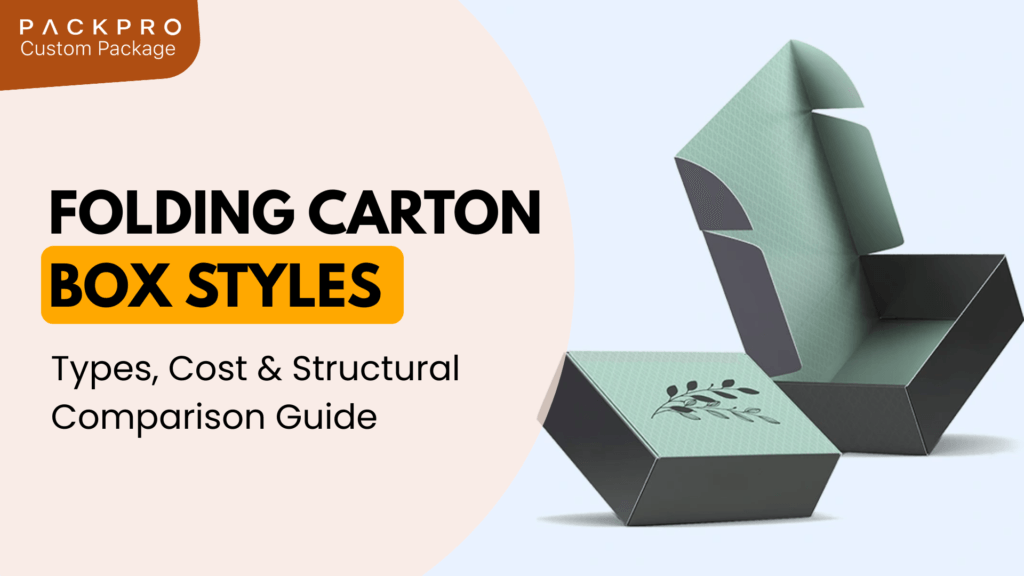
Selecting the right folding carton box styles is one of the most consequential decisions in packaging development. The structural format of a box directly affects how a product is protected, how it is presented on shelf or in transit, how quickly it can be assembled, and how much it costs to produce and ship. Despite this significance, many brands make structural choices based on familiarity rather than informed comparison.
Quick answer: Folding carton box styles differ in how they open, close, and assemble. Straight tuck end boxes are the most widely used for retail. Reverse tuck end boxes offer easier machine assembly. Seal end boxes provide stronger base closures. Gable top boxes add functional value for liquids. Each style carries different cost, production speed, and structural performance implications.
This guide provides a detailed structural comparison of the primary folding carton styles used in global packaging, with practical cost and performance context for each.
What Is a Folding Carton?
A folding carton is a lightweight paperboard packaging structure that is manufactured flat, then folded and glued into a three-dimensional box shape. It is distinct from corrugated cardboard, which uses a fluted layer for added structural strength, and from rigid boxes, which are constructed from non-folding greyboard.
Folding cartons are used across a wide range of industries including food and beverage, cosmetics, pharmaceuticals, consumer electronics, and household goods. They are produced from coated or uncoated paperboard in various callipers, and can be printed with high-quality graphics, special finishes, and functional coatings depending on the application.
Straight Tuck End (STE)
The straight tuck end is the most commonly used folding carton style globally. In this configuration, both the top and bottom flaps tuck inward from the same direction, creating a clean, consistent visual appearance when the box is closed.
The STE is well suited to retail display because it presents uniformly on shelf and is easy to open for consumers. It is also straightforward to fill and close on automated packaging lines. The tuck flaps provide adequate closure for most dry goods applications but are not recommended for heavy or liquid products where a stronger base closure is needed.
From a cost perspective, STE boxes are among the most economical to produce. The die-cut shape is efficient in material usage and the simple fold sequence reduces assembly time and complexity.
Reverse Tuck End (RTE)
In a reverse tuck end configuration, the top flap tucks in from the front while the bottom flap tucks in from the back. This opposing tuck direction is specifically designed to improve machine handling on high-speed automated packing lines, where the reversed tucks prevent the box from accidentally opening during filling and conveying.
For brands operating high-volume automated production environments, the RTE is often preferred for its mechanical advantages over the STE. From a visual standpoint, the two styles look nearly identical once closed, making the choice primarily a production engineering decision.
Seal End (SE)
Seal end boxes replace the tuck flap closures with glued panels, creating a firmly sealed base. This construction is significantly stronger than either tuck end style and is the preferred choice for heavier products, products with sharp edges, or applications where base integrity during shipping is critical.
The trade-off is that seal end boxes cannot be easily re-closed once opened, as the glued base panels are not designed for repeated cycling. This makes them suitable for single-use or retail contexts where tamper evidence is a benefit rather than a drawback.
Seal end boxes are more expensive to produce than tuck end styles due to the additional gluing step, but the production premium is often justified by improved product protection and reduced damage rates.
Gable Top
The gable top configuration features a distinctive roof-shaped closure at the top, created by two triangular flaps that fold upward and interlock. This structure is primarily used for liquid and semi-liquid products including beverages, dairy, juices, and soups.
Gable top cartons are typically produced with moisture-resistant coatings or laminations that prevent liquid penetration. They can be resealed after initial opening, which adds functional value for the consumer. The distinctive roof shape also serves as a differentiating visual feature on shelf.
Production costs for gable top cartons are higher than standard folding carton styles due to the more complex die-cut shape and the requirement for specialised coating. They are not typically used for dry goods applications where the cost premium is not justified by functional need.
Tuck Top Snap Lock Bottom
This hybrid configuration combines a tuck closure at the top with an auto-lock or snap-lock bottom. The base assembles automatically when the flaps are pushed into position, creating a strong, stable base without requiring adhesive. The top uses a standard tuck closure for convenient consumer access.
The snap lock bottom is particularly valued in contexts where product weight or distribution stress requires a more reliable base than a standard tuck provides. It is commonly used for cosmetics, candles, and mid-weight food products.
Choosing the Right Style for Your Product
The correct folding carton style depends on the intersection of several factors: product weight, filling method, shipping conditions, consumer opening experience, and budget. There is no universally correct choice; the right decision requires evaluating these factors in combination.
For lightweight retail products with automated filling, the straight tuck end or reverse tuck end will typically offer the best balance of cost and functionality. For heavier products requiring shipping durability, the seal end or snap lock bottom provides more reliable performance. For liquids, the gable top remains the dominant choice.