
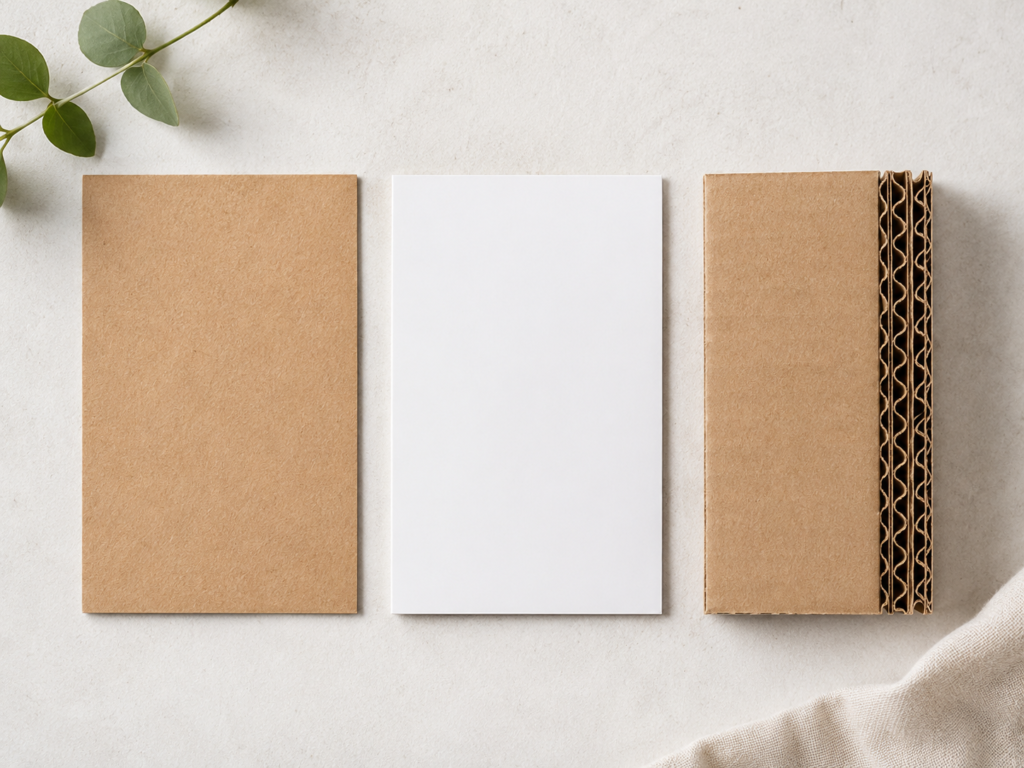
Pick the wrong material and you’ll find out one of two ways: your boxes arrive damaged, or your boxes arrive fine but look and feel cheaper than you wanted. Getting the material right the first time saves you both problems. Here’s how the three most common packaging materials actually differ.
Kraft paper: the natural, honest option
Kraft paper is that recognizable brown, slightly textured stock you’ve seen on everything from coffee bags to shoe boxes. It’s made using a pulping process that leaves the fibers strong relative to its weight, and it’s usually left unbleached — which is exactly why it has that natural, earthy look.
That look isn’t just aesthetic. It signals something to customers before they read a word: simple, natural, not over-processed. Brands in food, wellness, and sustainable-leaning categories lean on kraft for exactly this reason.
Kraft’s limitations are worth knowing too. It doesn’t print as crisply or vividly as bleached board — colors come out slightly muted rather than punchy. And on its own, standard kraft isn’t as rigid as paperboard, so it’s more common in mailer boxes, bags, and lighter folding cartons than in boxes meant to feel substantial in the hand.
SBS paperboard: the clean, print-ready choice
SBS (solid bleached sulfate) paperboard is the smooth, bright white stock behind most retail boxes you’d see in a cosmetics aisle or on a store shelf. Because it’s bleached and coated, it takes print exceptionally well — colors come out sharp, and fine detail holds up.
This is the material of choice when your packaging needs to look polished and your design has any real complexity to it — gradients, photography, fine text. It also folds cleanly, which matters for structural details like tuck flaps and locking tabs.
The tradeoff is that SBS paperboard, especially in lighter weights, doesn’t have the raw strength of corrugated board. It’s built for presentation and moderate protection, not for surviving a rough shipping journey on its own. A lot of premium folding cartons use SBS for the visible structure and rely on separate protective packaging (or a shipping box) around it for transit.
Corrugated: built for protection first
Corrugated board is the fluted, layered material most shipping boxes are made from — a wavy inner layer sandwiched between two flat liners. That fluted structure is what gives corrugated its strength; it distributes pressure and resists crushing far better than a single flat sheet of paper or board. Our post on the advantages of using corrugated boxes goes into more depth on this.
If your product needs to survive a shipping journey — bouncing around in a delivery van, stacked under other packages in a warehouse — corrugated is the material actually built for that job. It comes in different flute sizes and wall counts (single-wall, double-wall) depending on how much protection you need, which is part of why it’s the default for e-commerce shipping boxes and larger product packaging.
What corrugated gives up is finesse. It doesn’t take fine print detail as sharply as SBS paperboard, and its texture is more utilitarian than luxurious — though printed, laminated corrugated has come a long way and can still look sharp for brands that want a sturdier, more rustic presentation.
Matching the material to the job
A rough way to think about it: kraft for a natural, understated look on lighter items; SBS paperboard when your design needs to look sharp and your product doesn’t need heavy-duty protection on its own; corrugated when the box’s main job is keeping something safe in transit.
Plenty of packaging actually combines materials — an SBS paperboard rigid box for presentation, shipped inside a corrugated mailer for protection. That combination gets you the polished unboxing moment without asking a delicate material to do a shipping box’s job. For more on how material choices intersect with sustainability, see our sustainable packaging materials guide.
If you’re not sure which fits your product, the safest test is physical: order a sample in each material you’re considering and see how it holds up to the same handling your product will actually go through. Talk to our team about which material makes sense for your order.