
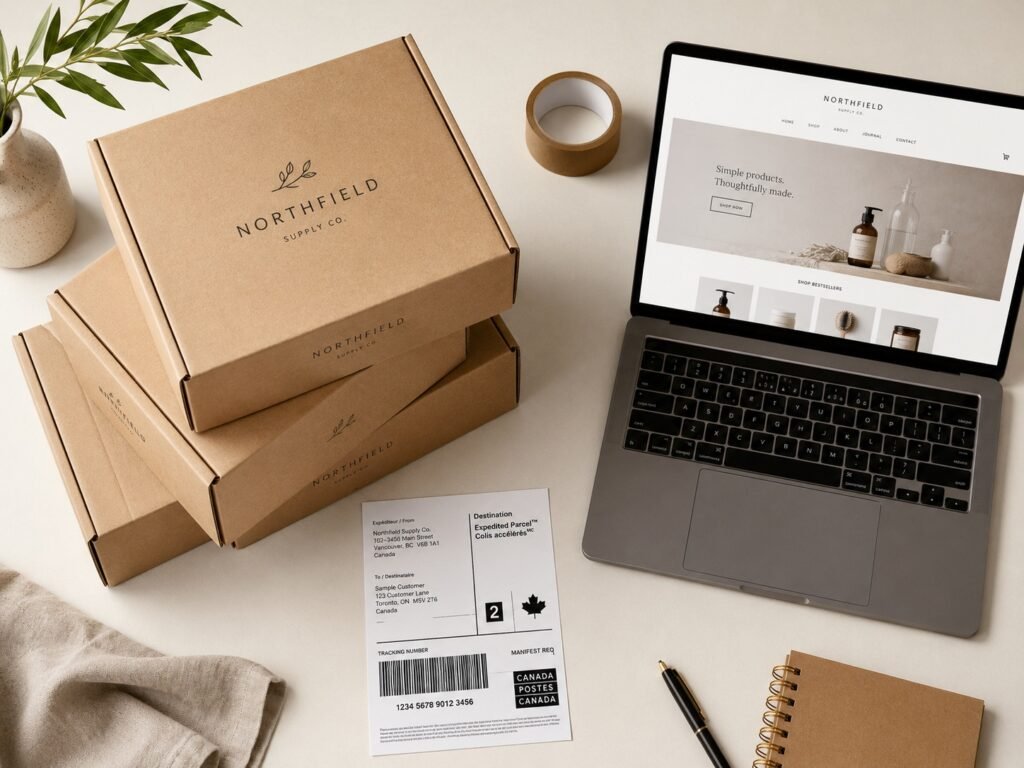
If you’re running an e-commerce brand out of Toronto, Vancouver, or anywhere else in Canada, you’ve probably hit the same wall every small brand hits: most packaging factories want you to order thousands of units before they’ll even talk to you. Five thousand. Ten thousand. For a brand that’s still testing which SKUs actually sell, that’s not realistic.
That wall is exactly what low-MOQ, factory-direct packaging is built to remove.
Why Canadian brands get stuck on MOQ
Traditional packaging manufacturing was built for big retailers with predictable, large-volume orders. A factory sets up a print run, a die-cut, and a production line once, then wants to spread that setup cost across as many boxes as possible. That’s how you end up with minimums in the thousands. For the full breakdown of how MOQ pricing actually works, see our guide on packaging MOQ, costs, and how to negotiate.
For a startup or small Canadian brand, that math doesn’t work. You don’t want a warehouse full of boxes for a product you might redesign in six months. You want enough packaging to launch, sell, and reorder as you grow — not a five-year supply sitting in storage.
Low MOQ packaging flips that model. Digital printing technology now lets factories produce short runs — as few as a couple hundred boxes — at the same print quality you’d get from a run of ten thousand. You’re no longer paying a volume tax just to get custom branding on your box.
What “low MOQ” actually means in practice
When a supplier advertises low MOQ, ask what the number actually is. “Low” can mean 1,000 units at some factories and 300 at others. A minimum order starting around 300 units is realistic for most small brands — enough to cover a launch or a few months of sales without tying up cash in inventory you don’t need yet.
That smaller order also means your money goes further elsewhere. Instead of parking your budget in a warehouse, you can put it toward product development, ads, or shipping — the things that actually move a small brand forward.
DDP shipping: the part Canadian buyers often miss
Ordering from an overseas factory isn’t just about the box price. It’s about what happens when that box crosses the border.
DDP — Delivered Duty Paid — means the supplier handles duties, taxes, and customs clearance before your order reaches you. You get a landed cost upfront, not a surprise bill from a customs broker weeks later. For a Canadian brand ordering internationally for the first time, this matters more than the per-unit price. It’s the difference between a predictable invoice and a shipment stuck at the border while you scramble to sort out paperwork.
Ask any supplier directly: is DDP included, or are you responsible for clearing customs yourself? That one question changes your total cost and your timeline.
What Canadian e-commerce brands typically order
Most small Canadian brands sourcing custom packaging fall into a few categories:
- Mailer boxes and shipping boxes for direct-to-consumer orders
- Rigid boxes for higher-end products like skincare, jewelry, or gifting
- Folding cartons for retail-ready products sold in stores or on shelves
Whatever the format, the same low-MOQ logic applies. You don’t need to commit to a huge volume to get a professional, branded unboxing experience.
Samples before bulk
Before placing a full order, ask for a physical sample. A photo or digital proof won’t tell you how the board feels, how the print looks under real light, or whether the box holds its shape once it’s packed. A sample costs little compared to finding out — after 300 units have shipped — that the color is off or the stock feels flimsy.
Once your order is placed, it’s worth thinking ahead to how you’ll store it — our guide on managing packaging inventory covers how to avoid overstock and stockouts as you grow.
Getting started
If you’re a Canadian brand ready to move past generic shipping boxes, the process usually looks like this: share your product dimensions and design ideas, get a quote and sample, approve the design, then place your order with DDP shipping built in. No 5,000-unit commitment required, and no guessing on landed cost once the boxes reach you. Talk to our team about sourcing low MOQ packaging for your brand.
Related Reading
- Packaging MOQ Explained: Minimum Order Quantities, Costs & How to Negotiate
- How US E-commerce Brands Get Custom Boxes from China with Low MOQ
- How to Manage Packaging Inventory for Your Business
Frequently Asked Questions
What’s a realistic MOQ for a Canadian startup ordering custom boxes?
Minimums starting around 300 units are realistic with factory-direct, low-MOQ suppliers, compared to the 5,000 to 10,000 units many traditional manufacturers require.
Does DDP shipping cover Canadian duties and taxes?
DDP (Delivered Duty Paid) means the supplier handles duties, taxes, and customs clearance before the shipment reaches you, so you get a single landed cost instead of a separate customs bill later. Confirm the exact scope with your supplier before ordering.
Should I order a sample before placing a bulk order?
Yes. A physical sample shows you how the board feels, how print colors actually look, and whether the structure holds up — details a digital proof can’t fully capture.