
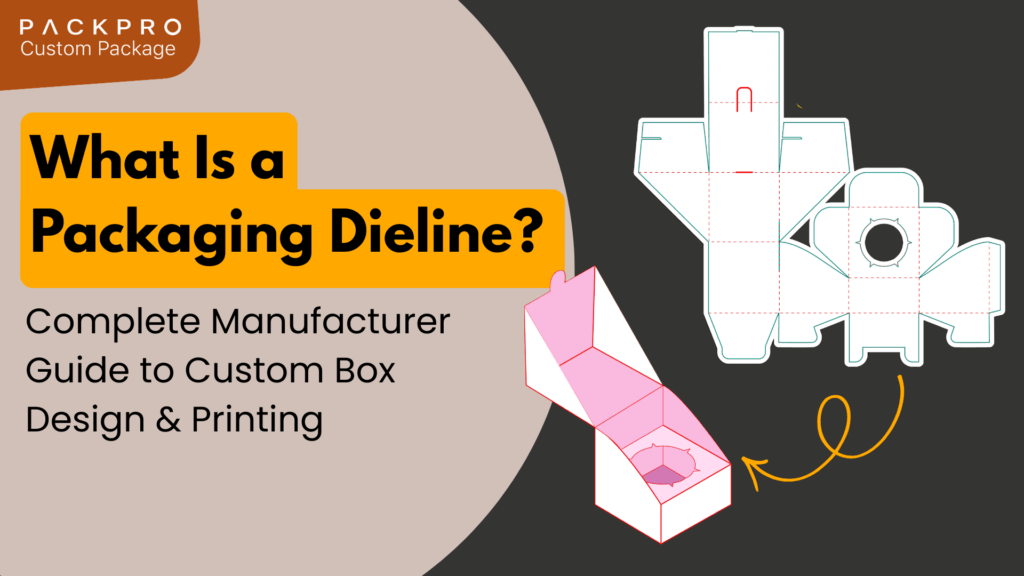
In high-volume custom manufacturing, the gap between a stunning digital concept and a functional physical product is bridged by one critical technical file: the dieline. For brand managers and sourcing teams overseeing global supply chains, understanding the mechanics of a packaging dieline is not just a design requirement—it is a risk management strategy. A precise dieline prevents costly production errors, ensures structural integrity during shipping, and guarantees that your artwork aligns perfectly with the physical substrate.
What is a packaging dieline?
A packaging dieline is a 2D flat vector template that outlines the exact cuts, folds, creases, and glue tabs required to manufacture a 3D physical package. It acts as the engineering blueprint for die-cutting machines, ensuring that the printed artwork and structural design align perfectly during mass production.
Without a professionally engineered dieline, even the most sophisticated graphic design will fail on the production line. As a manufacturer with over 20 years of experience serving global markets, we see firsthand how structural precision dictates the success of your final product.
What Is a Packaging Dieline? (Definition & Function)
At its core, a packaging dieline is the flattened geometry of your box. It is the file that tells our die-cutting machinery exactly where to cut the paperboard and where to press creases for folding.
In the context of a custom packaging factory in China, the dieline serves as the primary communication tool between your creative team and our structural engineers. It translates aesthetic intent into mechanical instruction. When you export goods to markets like the USA or Europe, where retail standards are exacting, the dieline ensures that every unit in a run of 50,000 matches the approved prototype.
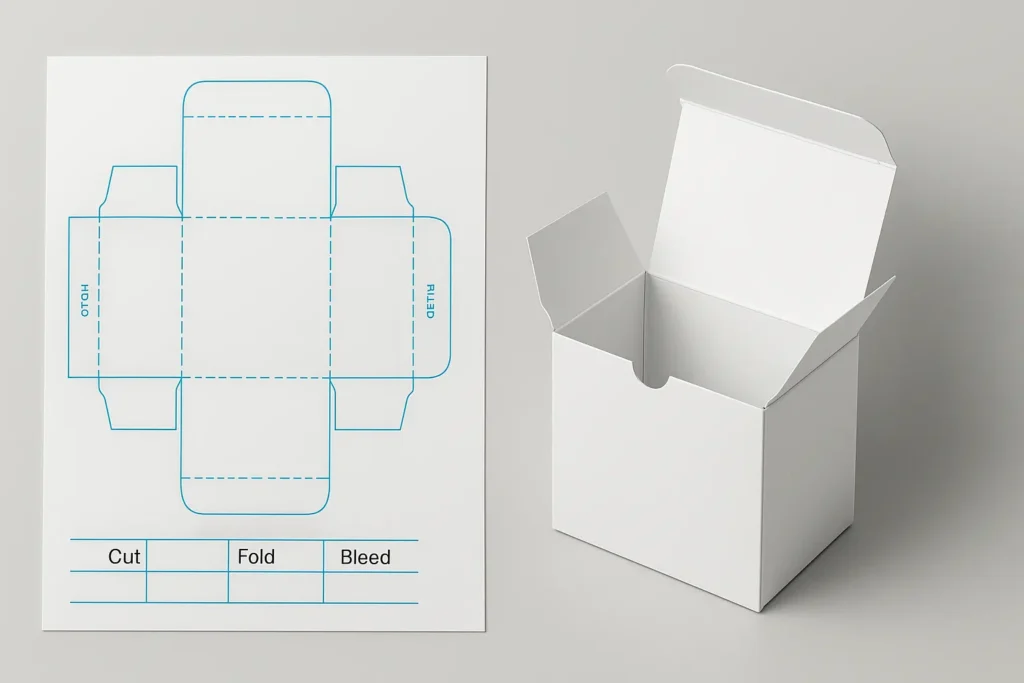
For professional designers, the dieline is the canvas. It indicates safe zones for text, bleed areas for background colors, and the orientation of panels to ensure that when the box is assembled, the graphics face the correct direction.
Why Dielines Are Critical for Structural Packaging Design
Structural packaging design is about more than just holding a product; it is about protecting it through the supply chain and presenting it effectively at the point of sale. The dieline is the foundation of this structure.
1. Ensuring Product Fit and Safety
A dieline is derived from the physical dimensions of the product itself. If the dieline is off by even 1mm, the product may rattle inside the box, leading to damage during transit, or the box may bow outwards, compromising stacking strength.
2. Optimizing Material Usage
Efficient dielines are crucial for cost control. In mass production, we nest multiple dielines onto a large parent sheet of paper. A well-optimized custom box dieline template minimizes waste between cuts, directly impacting unit cost—especially when using premium FSC-certified papers.
3. Automating Assembly
For brands using automated packing lines, the dieline dictates how the box interacts with packing machinery. If a glue tab is too short or a fold line is too stiff, it can jam automated packers, causing significant downtime.
Key Components of a Custom Box Dieline Template
To review a dieline effectively, you must understand its anatomy. Professional dielines use specific color codes and line styles to differentiate between various machine actions.
Cut Lines
Usually represented by a solid red or black line. This indicates where the steel rule die will cut completely through the material. This forms the outer edge of the flattened box and any internal windows or cutouts.
Fold Lines (Score Lines)
Often represented by a dashed or red line. These lines tell the machine to press an indentation into the material without cutting through it. This weakens the board just enough to allow for a clean, straight fold without cracking the printed surface.
Bleed Areas
This is the zone extending 3mm to 5mm beyond the cut line. Artwork must extend into this area to account for slight mechanical shifts during cutting (tolerance is typically ±0.5mm to 1mm). Without bleed, you risk having unsightly white slivers at the edge of your box.
Safe Zones
Located 3mm to 5mm inside the cut and fold lines. All critical text, logos, and barcodes must remain within this zone to prevent them from being trimmed off or folded over during assembly.
Glue Areas
Marked sections (often hatched or shaded) that indicate where adhesive will be applied. These areas must remain free of varnish, laminate, or ink, as these coatings can interfere with glue adhesion and cause the box to fall apart.
Understanding the visual language of a dieline is essential for approval. Here is how a standard professional file is structured.
Anatomy of a Packaging Dieline (Visual Explanation)
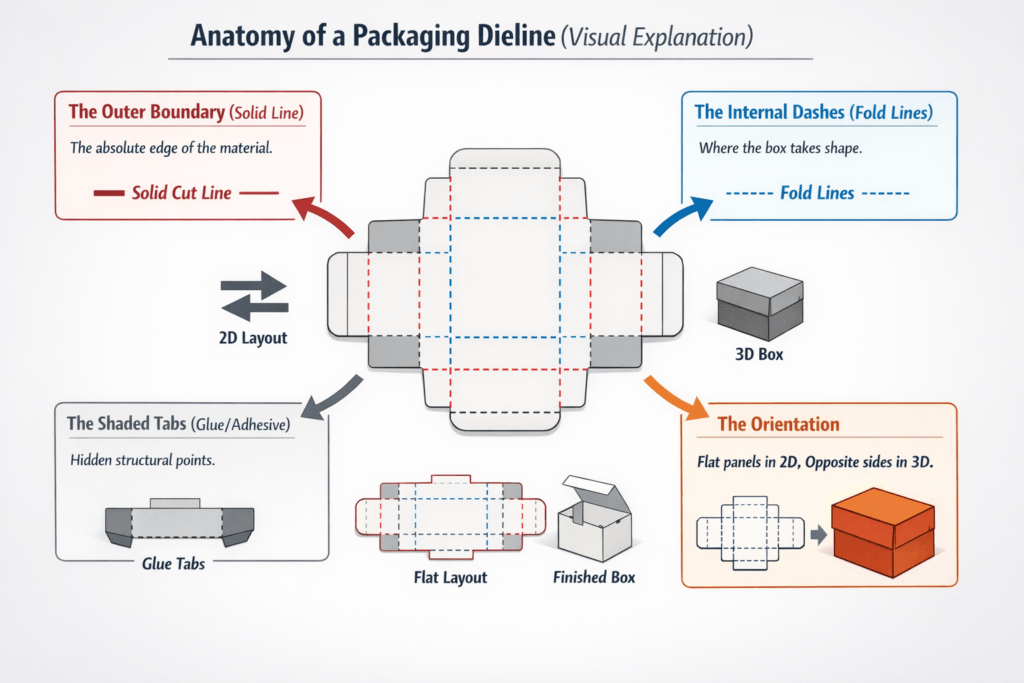
- The Outer Boundary (Solid Line): The absolute edge of the material.
- The Internal Dashes (Fold Lines): Where the box takes shape.
- The Shaded Tabs (Glue/Adhesive): Hidden structural points.
- The Orientation: Panels are often laid out flat. Remember that panels next to each other in 2D may be on opposite sides in 3D.
Note: We always encourage brands to request a structural consultation before applying final artwork. Our engineering team often refines dielines to improve stability or manufacturability before the design phase begins.
Difference Between Folding Carton and Rigid Box Dieline Design
Not all packaging is created equal. The structural engineering required for a lightweight folding carton differs vastly from that of a premium rigid box.
Folding Cartons
Folding cartons (like toothpaste boxes or cosmetic creams) are made from a single layer of paperboard (SBS or C1S).
- Dieline characteristic: The dieline is a single, continuous shape.
- Assembly: It is folded and glued in one pass.
- Complexity: Generally simpler, but requires high precision for auto-locking bottoms.
- Folding Carton Packaging Solutions
Rigid Boxes (Set-Up Boxes)
Rigid boxes (like iPhone boxes or luxury jewelry packaging) consist of a thick chipboard structure wrapped in a thin paper sheet.
- Dieline characteristic: You actually need two dielines. One for the greyboard structure (the skeleton) and one for the wrapping paper.
- Wrapping: The wrapping paper dieline is larger than the board dieline to allow for the paper to be wrapped around the edges and turned in.
- Complexity: High. The interaction between the board thickness and the wrap paper requires precise calculation to ensure the lid slides onto the base with the perfect amount of friction (vacuum suction).
- Custom Rigid Box Manufacturer
Common Mistakes Designers Make with Dielines
Even experienced graphic designers can make errors if they are not familiar with packaging printing guides and manufacturing constraints.
- Ignoring Material Thickness: In 2D, lines have no thickness. In 3D, material has volume. If a dieline doesn’t account for the thickness of the corrugated board or rigid chipboard, the folded box will be distorted.
- Placing Artwork Over Glue Flaps: If ink or varnish covers a glue flap, the adhesive won’t stick. This results in boxes popping open during transit.
- Incorrect Panel Orientation: Designers often place logos upside down on the back panel because it looks “right” on the flat screen. Visualizing how the box folds is critical.
- Insufficient Bleed: Digital printing is exact; mechanical die-cutting has a tolerance. Lack of bleed is the most common reason for artwork rejection.
How Incorrect Dielines Increase Production Costs
A flawed dieline is a financial liability. If an error is not caught during the digital proofing stage, it escalates rapidly.
- Tooling Costs: Creating a physical cutting die involves laser-cutting wood and embedding steel blades. If the dieline is wrong, the physical die must be scrapped and remade.
- Material Waste: If 10,000 sheets are printed based on an incorrect dieline, the entire run is waste. This is not only a financial loss but an environmental failure.
- Freight and Returns: If a box fails structurally because of a bad dieline, products may be damaged. The cost of replacing goods and air-freighting new packaging often exceeds the original order value.
From Concept to Production: Dieline Development Process
To ensure accuracy, our factory follows a strict step-by-step workflow. This prevents errors and aligns your creative vision with manufacturing reality.
Step 1: Product Measurement
We never guess. We request the physical product to measure its dimensions, weight, and fragility. This determines the necessary material strength and box style.
Step 2: Structural Engineering
Our team creates a CAD file. We calculate allowances for material thickness and fold radii.
Step 3: CAD Development
The technical drawing is finalized. This digital file is the “master” dieline.
Step 4: Prototype Sample (White Sample)
We cut an unprinted sample using a sampling table (plotter). We test this sample with your product to verify fit and structure.
Step 5: Artwork Alignment
Once the white sample is approved, we send the dieline to your design team. You apply the artwork, and we check it for bleed, resolution, and color separation.
Step 6: Mass Production Die Cutting
We manufacture the steel rule die based on the final approved file and begin mass production.
Printing Considerations in Packaging Dielines
The dieline also dictates how we apply finishes.
- Spot UV and Foil Stamping: These require their own separate layers in the dieline file. They must register perfectly with the print and cut lines.
- Embossing: Embossing alters the physical shape of the paper. The dieline must ensure that embossed areas do not interfere with fold lines, which could cause the paper to tear.
- Varnish Free Areas: As mentioned, glue tabs must be marked in the dieline as “varnish-free” to ensure structural integrity.
File Formats Used in Professional Packaging
To ensure seamless production, we require specific file formats.
- Adobe Illustrator (.AI): The industry standard. Vectors are scalable and editable. This allows us to make minor technical adjustments if necessary.
- PDF (Press Quality): Acceptable for viewing and printing, provided layers are preserved.
- CAD (.DXF, .CFF2): These are purely structural files used by our engineering team and die-making machines. They do not contain artwork.
- Avoid: JPEGs, PNGs, or Photoshop files with flattened text. These cannot be used for dieline production.
How a Custom Packaging Factory in China Supports Structural Engineering
Partnering with a manufacturer that has in-house structural engineering is a competitive advantage. Many sourcing agents or basic print shops lack this capability, relying on generic templates.
At our facility, we combine 20+ years of export experience with advanced engineering. We don’t just print your file; we audit it. Our ISO-certified processes ensure that the dieline you approve is exactly what comes off the line. Whether you need a complex rigid box or a sustainable folding carton, our capacity of 50,000+ units per day is backed by rigorous technical validation.
Sustainable Luxury Packaging Guide
How Accurate Dielines Reduce Waste, Returns & Production Delays
Precision in the dieline phase is the biggest driver of ROI in packaging procurement.
Avoiding Material Waste
Accurate nesting of dielines on the parent sheet maximizes yield. This is critical for sustainability goals and cost reduction.
Preventing Reprints
By validating the dieline against a physical prototype before mass printing, we eliminate the risk of unusable stock.
Protecting Brand Consistency
A box that closes with a satisfying “click” or a rigid box with perfect vacuum friction conveys luxury. Loose, ill-fitting boxes degrade brand perception. Accurate dielines protect this brand equity.
Improving Supply Chain Efficiency
Boxes that are structurally sound stack better on pallets. This maximizes shipping density and reduces the likelihood of crushed cartons during ocean freight or warehousing.
Outbound Authority References
To further understand the technical standards we adhere to, we recommend referencing:
- International Organization for Standardization (ISO): For global standards on packaging dimensions and testing.
- Forest Stewardship Council (FSC): For guidelines on sourcing sustainable paper materials. Luxury Jewelry Packaging Comparison
- International Safe Transit Association (ISTA): For performance testing standards to ensure packaging survives shipment.
Why do we link to these standards? Because compliance with recognized engineering and sustainability protocols builds trust and ensures your packaging meets global import regulations.
FAQ: Packaging Dielines & Manufacturing
Conclusion
A packaging dieline is the unsung hero of the unboxing experience. It is the intersection of creative vision and manufacturing reality. For premium brands, the cost of a dieline error is measured not just in dollars, but in reputation.
When you work with a manufacturing partner who understands structural packaging design, you are not just buying a box; you are investing in supply chain security and brand integrity. With over two decades of experience serving the world’s most demanding markets, our engineering team ensures that your packaging performs as beautifully as it looks.
Ready to secure your production?
Request a structural consultation and dieline review from our packaging engineering team today. Let us optimize your design for manufacturing precision and global export.