
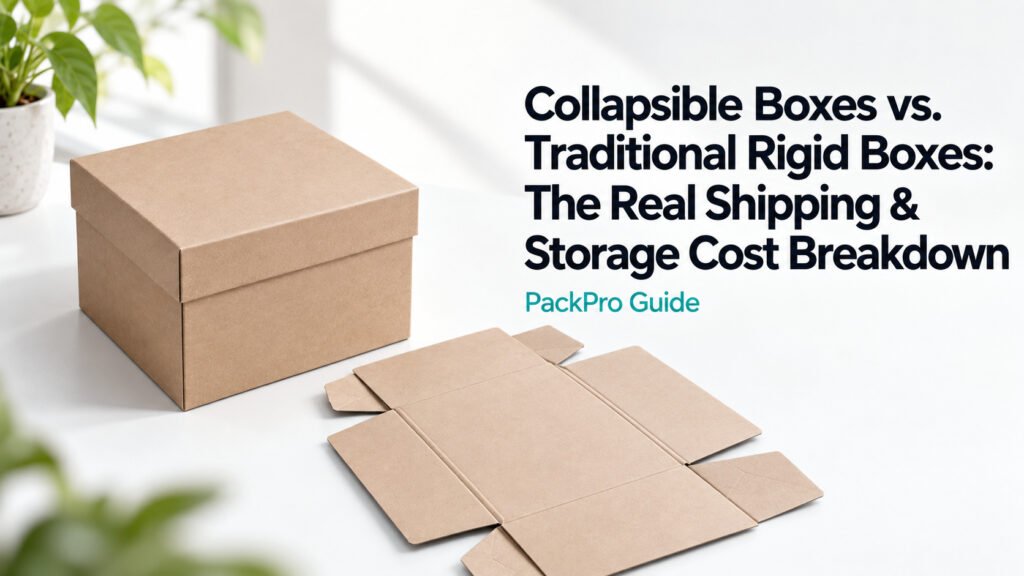
“Collapsible boxes save money on shipping” is one of those claims that gets repeated so often in packaging marketing that it stops meaning anything specific. Save how much? Compared to what? Here’s the actual math, using real production figures, so you can run it against your own order size instead of taking the claim on faith.
The Core Difference, in One Number
A traditional rigid box ships and stores pre-assembled — it takes up its full finished shape from the moment it leaves the factory. A collapsible rigid box folds flat, then locks into shape, often with hidden magnets, when someone actually needs it. Per 1,000 units, production data puts pre-assembled rigid boxes at roughly 8.4 cubic meters of shipping volume, versus about 2.5 cubic meters for the same 1,000 units flat-packed — close to a 70% reduction in the volume you’re paying to move and store.
What That Actually Means for a Container
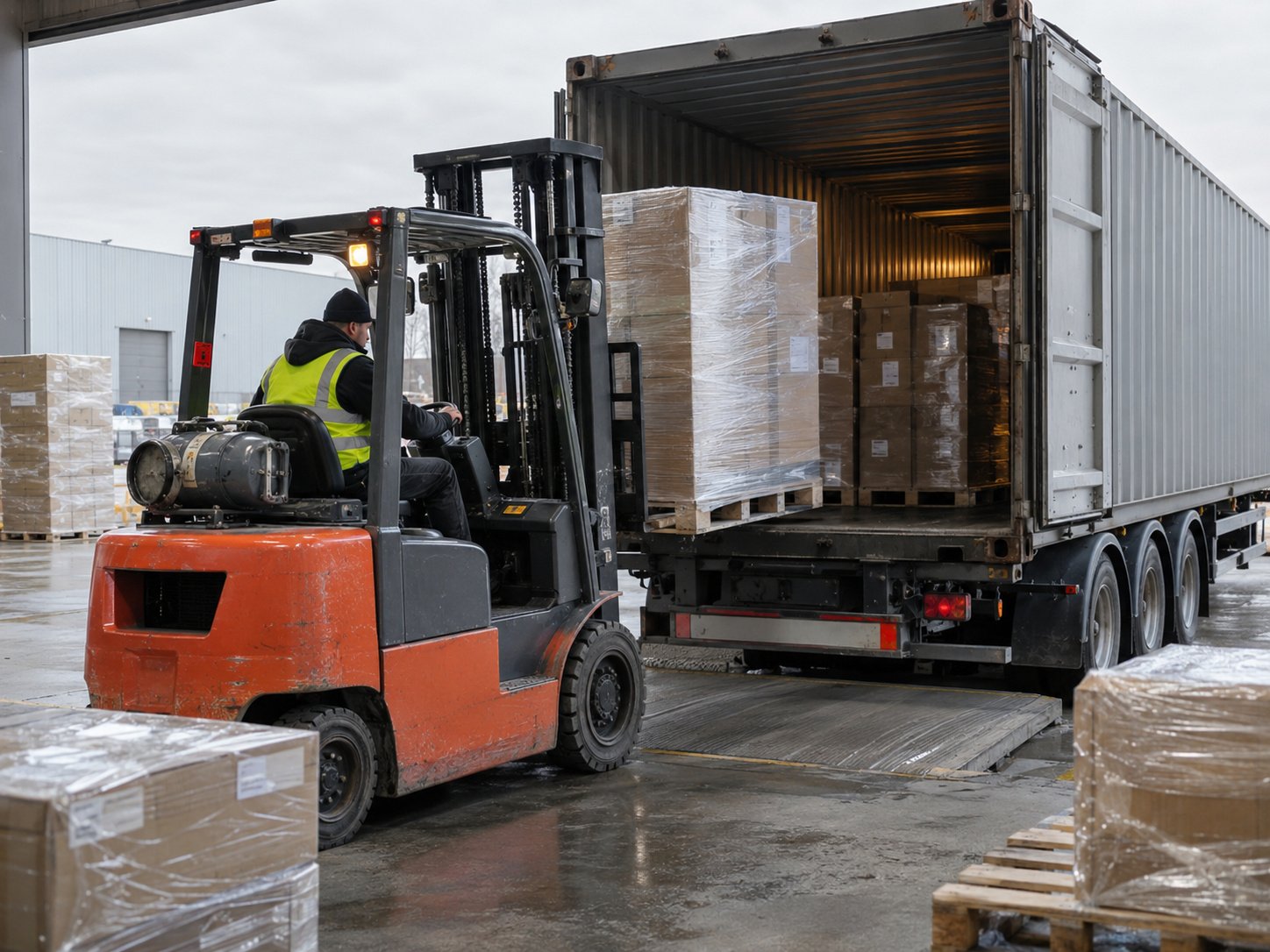
“70% less volume” is easy to nod along to and hard to actually feel. So here’s the same math applied to a standard 40-foot shipping container, which holds roughly 60 cubic meters of usable, palletized cargo space:
| Pre-Assembled Rigid | Collapsible Rigid (Flat) | |
|---|---|---|
| Volume per 1,000 units | ~8.4 m³ | ~2.5 m³ |
| Approx. units per 40ft container* | ~7,100 | ~24,000 |
| Containers needed for 20,000 units | ~3 | ~1 |
*Illustrative estimate based on roughly 60m³ of usable container capacity; your actual figures will vary with box dimensions, palletizing method, and carrier.
That’s not a marginal difference. Moving 20,000 units of a pre-assembled rigid box could take roughly three containers; the same 20,000 units flat-packed could plausibly fit in one. Every container you don’t need is freight cost, port handling fees, and customs clearance you’re not paying for.
Where the Savings Show Up Beyond the Container
- Warehouse footprint — flat-packed inventory takes a fraction of the shelf or floor space of the same quantity pre-assembled, which matters directly if you’re paying a 3PL by the pallet or square foot.
- More inventory per storage dollar — because flat storage is so much more space-efficient, brands often order and hold a larger quantity per run without a proportional jump in storage cost.
- Lower dimensional-weight shipping charges on the final mile too, if the collapsible format also ships flat to the end customer rather than fully assembled.
Where Traditional Rigid Boxes Still Win
None of this makes pre-assembled rigid boxes obsolete. They’re still the stronger choice when the box needs maximum wall rigidity straight out of the factory with zero assembly anywhere in the chain, when the design relies on a construction method that doesn’t fold well (certain telescoping or drawer-style boxes, for instance), or when order volume is small enough that freight savings don’t offset a higher unit cost for collapsible tooling. Collapsible construction typically carries a modest cost premium per unit over the simplest rigid formats — the savings show up in freight and storage, not necessarily on the per-box price tag.
How to Tell Which One Makes Sense for Your Order
Run the math on your own numbers before deciding: your unit volume assembled and flat (your supplier can provide this), your shipping distance and method, and your monthly storage cost per cubic meter or pallet position. As a rough rule of thumb, the larger your order volume and the longer your goods sit in a warehouse before use, the more the collapsible format’s savings compound.
Frequently Asked Questions
Is a 70% shipping and storage reduction accurate for every product?
It’s representative of typical rigid gift box dimensions, not a universal guarantee — your actual reduction depends on your specific box size and how efficiently both formats palletize. Ask your supplier for volume figures on your exact box before finalizing an order.
Does a collapsible box cost more per unit than a standard rigid box?
Often slightly, yes — the folding mechanism, commonly magnetic closures, adds a modest per-unit cost. The tradeoff is usually worth it once freight and storage savings are factored in, especially at higher order volumes.
Can collapsible rigid boxes still look premium?
Yes. A well-made collapsible rigid box looks and feels identical to a pre-assembled one once it’s locked into shape — the flat-pack advantage is invisible to the end customer.
At what order size do the savings become worth it?
There’s no fixed threshold, but savings scale with volume and shipping distance — a small domestic order may not justify it, while a container-scale international order usually will.
See the Numbers on Your Own Order
Send PackPro your box dimensions and we’ll include both assembled and flat volume figures with your quote, so you can run this exact comparison for your own product. Request a free quote today — we respond within 24 hours.
Get a Free Quote → packpropkg.com/contact
Related Guides
- Format comparison — Collapsible Rigid Boxes vs Standard Rigid Boxes: Shipping & Storage Cost Comparison
- PPWR & compliance angle — How the EU’s 2026 PPWR Packaging Rules Are Changing Box Design
- Collapsible box benefits — Benefits of Using Collapsible Rigid Boxes