
By the PackPro packaging engineering team, Dongguan, China. Last updated 2026-11-09.
Quick answer: To size a rigid box, start with the product’s largest length, width and height, add insert thickness on every side, add a small working clearance (typically 2 to 4 mm per dimension for a snug but easy pack), and then confirm the lid and fit tolerances for the structure (lid-and-base, drawer or magnetic). Always specify internal dimensions, state the tolerance (commonly plus or minus 1 to 1.5 mm), and approve a white sample with the real product before production.
Choosing a box size sounds simple until you realise there are three different sets of dimensions: the product, the internal box size, and the external size that affects shipping. Mixing them up is the most common sizing mistake. This guide gives you a repeatable method.
For the fit problems that follow from bad sizing, see Lid Too Tight or Too Loose? and Magnetic Box Lid Won’t Close Flush.
Step 1: Measure the product correctly
- Measure the maximum length, width and height, including caps, pumps, buttons and protrusions.
- Weigh the product and note any parts that move or must be accessible.
- If you have several items in a set, measure the full arrangement, not each item separately.
- Measure the actual production units, not design drawings, because bottles and moulded parts vary.
Step 2: Add the insert and clearance
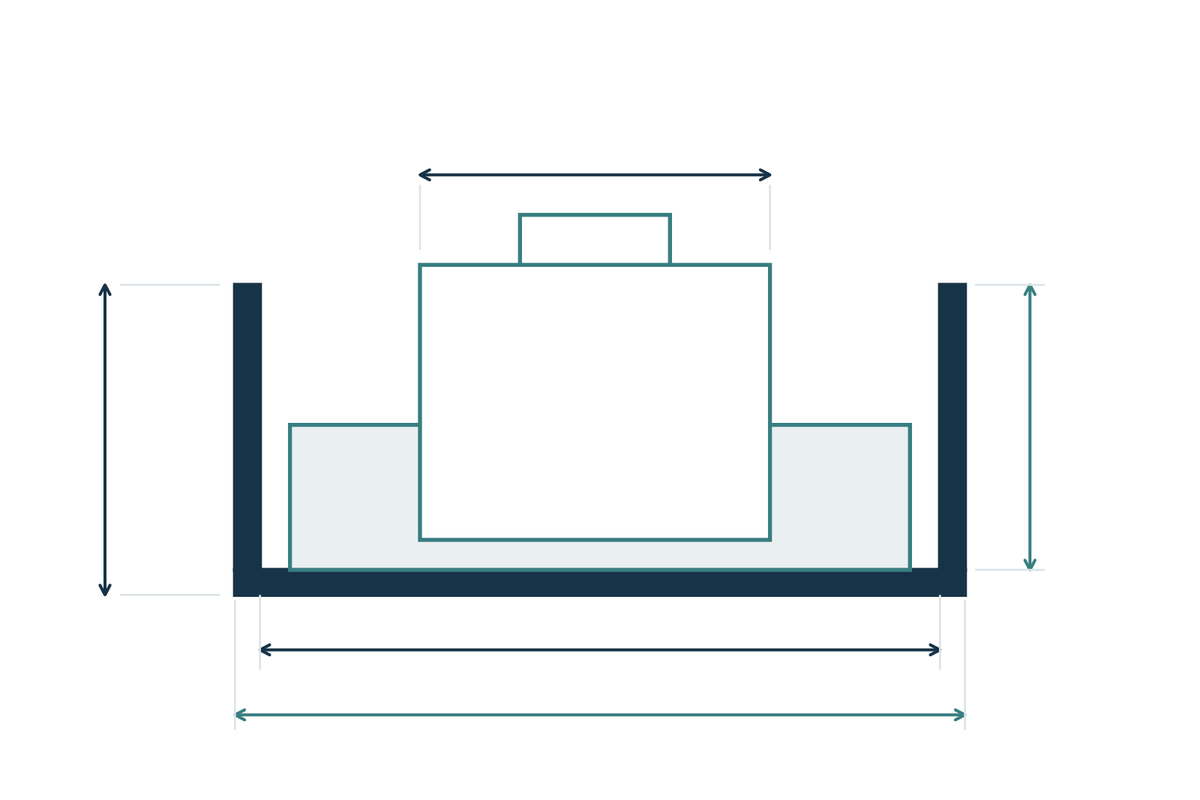
Internal dimension = product dimension + insert wall thickness on both sides + working clearance.
| Allowance | Typical range (guide) | Notes |
|---|---|---|
| Foam or EVA insert wall | 3 to 10 mm per side | Thicker for fragile items |
| Paper or pulp insert wall | 2 to 5 mm per side | Depends on material |
| Working clearance for easy pack-in | 1 to 2 mm per side | Prevents forcing the product |
| Product height clearance (lid side) | 2 to 3 mm below the base rim | Prevents the lid lifting |
These are common guidance ranges. Confirm them on a sample, because cavity cuts and material compression vary.
Step 3: Apply structure-specific rules
| Structure | Key sizing rule | Watch out for |
|---|---|---|
| Lid-and-base box | Lid inner size = base outer size + clearance (about 1 to 2 mm total) | Wrap thickness, neck height |
| Drawer box | Sleeve inner size = tray outer size + clearance (about 1 to 2 mm total) | Humidity swelling, tray stiffness |
| Magnetic flip-top box | Base height must exceed product plus insert height; lid depth matches base wall | Hinge play, magnet position |
| Collapsible rigid box | Base height and fold geometry limit the maximum product height | Tall products may need a different structure |
Step 4: Work through an example
A 50 ml serum bottle with a pump measures 40 mm (diameter) by 120 mm (height). You want a magnetic box holding it upright with a paper insert.
| Dimension | Calculation | Result (mm) |
|---|---|---|
| Internal width | 40 + (2 x 3 insert) + 2 clearance | 48 |
| Internal length | 40 + (2 x 3 insert) + 2 clearance | 48 |
| Internal base height | 120 + 3 insert floor + 3 clearance below rim | 126 |
Then confirm the external size by adding two board thicknesses plus wrap (for 2 mm board, about 4.5 to 5 mm total across both walls). External size is about 53 x 53 x 131 mm. Use the external size for carton and freight planning.
Step 5: Define tolerances
Rigid boxes are partially handmade, so state tolerances explicitly.
| Item | Common request (guide) |
|---|---|
| Length and width | Plus or minus 1 to 1.5 mm |
| Height | Plus or minus 1 to 1.5 mm |
| Lid clearance | Target value with a range (for example 1.5 mm, range 1 to 2 mm) |
| Insert cavity | Plus or minus 0.5 to 1 mm |
| Colour | Delta E limit or approved sample reference |
Tighter tolerances cost more because they increase rejects and inspection time, so apply them only where the product demands it.
Step 6: Check against shipping and retail
- Master carton fit: Calculate how many boxes fit per carton and pallet. A few millimetres can change the carton count.
- Retail shelf: Check shelf depth and display requirements.
- Collapsibility: If freight is a major cost, compare the flat-pack volume of a collapsible rigid box with a fully formed box.
- Compliance: Packaging weight by material may need to be reported in some markets, see UK rules.
Step 7: Approve a sample before ordering
- Request a white sample (unprinted) to confirm structure and fit.
- Test with the real product, packed and unpacked 20 times.
- Store the sample for 24 to 48 hours in conditions like your destination.
- Approve a pre-production sample with final materials and finishes.
- Record the approved measurements in the purchase order.
Use our RFQ template to put all of these into one brief, and consult the glossary for unfamiliar terms.
Frequently asked questions
Should I give internal or external box dimensions to the factory?
Give internal dimensions, since they determine whether the product fits. The factory calculates the external size from board and wrap thickness. Ask for the external size afterwards for shipping calculations.
How much extra space should a rigid box have around the product?
A common guide is 1 to 2 mm of working clearance per side, plus the insert thickness. Fragile products need thicker inserts, and heavy items need tighter support.
What tolerance should I accept on rigid box dimensions?
Plus or minus 1 to 1.5 mm is common for handmade rigid boxes. Request tighter tolerances only where fit demands it.
Can I use the same box size for different product versions?
Sometimes. Use the largest version for the internal size and add inserts for smaller versions, but check that the product does not rattle or tilt.
How do I size a box for a set of several products?
Measure the final arrangement as laid out in the insert, add the walls and clearance, and test the layout with real items.
Can PackPro recommend a size from my product samples?
Yes. Send product dimensions or a sample and our engineers will propose a structure and size through the quote form.
Planning a packaging project? Send us the brief.
Share your product dimensions, target quantity and destination market, and the PackPro engineering team will reply with a structural recommendation and a quotation. You do not need a finished design to start.
Request a custom quote | Email: info@packpropkg.com | WhatsApp / phone: +86 184 7552 0523
PackPro is the brand of Dongguan City XinHongCai Paper Products Co., Ltd, a factory-direct packaging manufacturer in Dongguan, China with FSC, BSCI, ISO 9001 and ISO 14001 certification (see certifications).
Related reading
Sources and further reading
- ISO 9001 quality management
- ISTA for packaging test procedures