
In the world of premium products, packaging is not merely a container; it is the first physical interaction a customer has with a brand. Luxury rigid boxes represent the highest standard in this exchange, offering unparalleled structural integrity, a premium tactile experience, and a perceived value that elevates the product within. Their construction signals quality and permanence, turning a simple unboxing into a memorable brand moment.
Luxury rigid box manufacturing is the specialized industrial process of engineering and producing high-end packaging from non-collapsible, thick paperboard. This process integrates precision cutting, advanced finishing techniques, and expert assembly to create durable, three-dimensional boxes that protect and enhance high-value products for global brands.
As a custom rigid box manufacturer with over 20 years of experience, we operate at the intersection of engineering and artistry. This guide provides a manufacturer-level overview of the complete luxury rigid box manufacturing process, from initial structural design to mass production and global distribution. We will explore the technical nuances, material choices, and quality control systems that define premium gift box production.
What Is a Luxury Rigid Box?
A luxury rigid box, also known as a set-up box, is a type of packaging constructed from thick, high-density paperboard (typically 1.5mm to 3mm), which is then wrapped in a decorative paper or fabric. Unlike folding cartons, rigid boxes are delivered pre-assembled and do not collapse, providing superior strength, durability, and a distinctively premium feel.
The core material, often called greyboard or chipboard, gives the box its inflexible structure. The choice of wrap material—from coated and uncoated papers to textiles and leatherettes—alongside various printing and finishing options, allows for extensive customization. These boxes are synonymous with luxury goods, including electronics, cosmetics, jewelry, and high-end apparel.
Why Premium Brands Choose Rigid Packaging
Procurement managers and packaging engineers at leading brands select rigid packaging for several strategic reasons that directly impact brand perception, product protection, and customer experience. The decision goes beyond aesthetics to address critical business objectives.
- Unmatched Product Protection: The robust construction of rigid boxes provides exceptional defense against impact, compression, and handling damage during shipping and retail. This is critical for fragile or high-value items.
- Elevated Perceived Value: The weight, sturdiness, and flawless finish of a rigid box communicate quality before the customer even sees the product. This enhances the perceived value and justifies a premium price point.
- Enhanced Unboxing Experience: Rigid boxes facilitate a structured and often dramatic unboxing sequence. Elements like magnetic closures, custom inserts, and ribbon pulls turn the process into a memorable, shareable event.
- Brand Permanence and Reuse: Consumers are more likely to keep and reuse a high-quality rigid box for storage. This extends the life of the packaging and keeps the brand visible in the customer’s home or office long after the initial purchase.
- Limitless Customization: The manufacturing process allows for a vast array of structural designs, from classic lid-and-base styles to complex drawer and hinged-lid configurations. This structural flexibility is complemented by endless finishing possibilities, including foil stamping, embossing, and custom coatings. For brands needing unique unboxing experiences, like those detailed in our [Internal link: PR Box Packaging Guide], this is a key advantage.
Step-by-Step Rigid Box Manufacturing Process
As a rigid packaging supplier with a daily capacity exceeding 50,000 units, we have refined a precise, multi-stage process. Each step is governed by strict quality controls compliant with our ISO 9001 certification.
Step 1: Structural Engineering & Dieline Development
The process begins with our advanced structural engineering team. They translate a brand’s concept into a functional, manufacturable design. This involves creating a digital 3D model and a 2D dieline—a precise schematic that dictates all cuts, creases, and grooves. Material selection is finalized at this stage, considering product weight, desired finish, and budget. For a deeper dive into this crucial first step, see our Packaging Dieline Guide.
Step 2: Greyboard Cutting & Grooving
Once the dieline is approved, we process the raw greyboard. Large sheets of FSC-certified board are fed into automated cutting machines. These machines precisely cut the board to size for the box base and lid. For boxes with sharp, 90-degree corners, a V-grooving machine is used to cut V-shaped channels into the board. This allows the board to be folded with perfect precision, creating the crisp edges characteristic of luxury packaging.
Step 3: Paper Printing & Finishing
Simultaneously, the selected wrap paper is prepared. The paper is printed with brand graphics using offset or digital printing technologies. After printing, various finishing processes can be applied to enhance the visual and tactile appeal:
- Lamination: A thin film (matte, gloss, or soft-touch) is applied for protection and texture.
- Foil Stamping: Metallic or pigmented foil is applied using heat and pressure.
- Embossing/Debossing: A die is used to create a raised or recessed impression in the paper.
- Spot UV: A high-gloss varnish is applied to specific areas for contrast.
Step 4: Wrapping & Turn-In Process
This is the core assembly stage. The printed and finished wrap paper is glued. The cut and grooved greyboard is then precisely positioned onto the adhesive side of the wrap. Automated wrapping machines fold the paper up and around the sides of the board. The edges of the paper that extend beyond the board are then carefully folded over the top edge and tucked inside—a process known as “turning in”—creating a seamless, finished look.
Step 5: Lid & Base Assembly
The wrapped components for the lid and base are formed into their final three-dimensional shape. Machines press the components into a mold, securing the corners and ensuring structural integrity. At our rigid box factory in China, this step combines high-speed automation with manual oversight to ensure every corner is perfectly formed and every surface is smooth.
Step 6: Magnet / Insert Installation
If the design includes features like magnetic closures, ribbon pulls, or custom inserts, they are installed at this stage. Magnets are carefully embedded within the greyboard before final assembly to be invisible. Custom inserts, made from foam, paperboard, or thermoformed plastic, are placed inside the box to hold the product securely. This is a critical step for products like those in our Luxury Jewelry Packaging Comparison.
Step 7: Quality Inspection & Packaging
Every completed rigid box undergoes a final, rigorous quality inspection. Our QC teams check for alignment, surface imperfections, structural soundness, and correct functionality of closures. Once approved, the boxes are carefully packed into master cartons designed for export, ensuring they arrive at their global destination in pristine condition.
Rigid Box vs Folding Carton Comparison
Choosing between a rigid box and a folding carton is a key strategic decision for packaging engineers. While both are paper-based, their material properties, manufacturing processes, and ideal applications differ significantly.
| Feature | Rigid Box | Folding Carton |
| Material Thickness | 1.5mm–3mm greyboard core. Extremely durable and non-collapsible. | 300gsm–800gsm paperboard (up to 28pt). Lightweight and flexible. |
| Premium Feel | High. Substantial weight, crisp edges, and seamless finish convey luxury. Offers a superior tactile experience. | Moderate. Lighter feel and visible fold lines. Premium feel is achieved through finishes, not structure. |
| Shipping Volume | High. Shipped pre-assembled, leading to higher shipping costs and warehouse space requirements due to volume. | Low. Shipped flat, significantly reducing freight costs and storage footprint before assembly. |
| Cost per Unit | Higher. Complex, multi-stage manufacturing process with more materials and labor involved. | Lower. Simpler, highly automated die-cutting and folding process results in a lower unit cost. |
| Best For | High-value products: electronics, spirits, cosmetics, jewelry, luxury gifts. When brand impression and protection are paramount. | Mass-market retail products: food, pharmaceuticals, software. When cost-efficiency and supply chain optimization are key. For more options, explore various Folding Carton Box Styles. |
Inside a Rigid Box Factory: How Precision Engineering Ensures Luxury Quality
Step inside a modern, large-scale custom packaging factory in China, and you will find a blend of advanced automation and irreplaceable human skill. Our facility, with its 50,000+ unit daily capacity, is engineered for precision at scale.
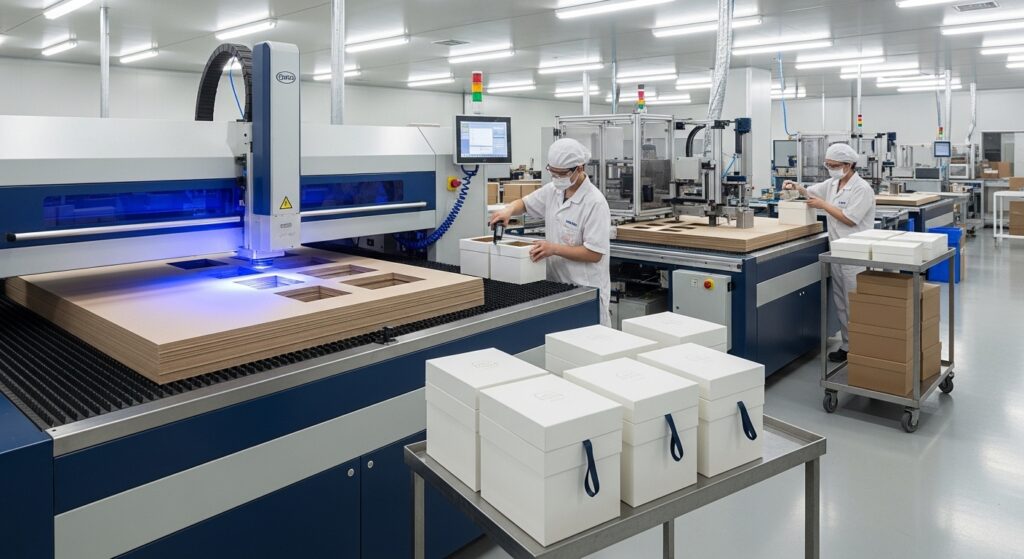
Machinery Used: We employ state-of-the-art equipment, including automated greyboard slitters, high-precision V-grooving machines, and fully automatic box wrappers. Heidelberg offset presses handle printing, ensuring color consistency, while automated die-cutters execute complex finishing details.
Skilled Labor: While machines perform heavy lifting, skilled technicians operate and calibrate them. These experts are crucial for setting up jobs, managing color profiles, and ensuring machinery runs within tight tolerances. Their expertise prevents errors that could compromise an entire production run.
Manual Craftsmanship: Certain tasks, particularly for highly complex or low-volume orders, demand manual craftsmanship. The application of delicate ribbons, the precise assembly of intricate multi-component boxes, and the final quality check often rely on the trained hands and discerning eyes of our assembly team.
Quality Checkpoints: Quality is not an afterthought; it is integrated throughout the process. Checkpoints exist after printing, after finishing, post-wrapping, and before final packing. We use spectrophotometers for color control and digital calipers for dimensional accuracy, all tracked within our ISO 9001 Quality Management System.
Export Packaging Standards: As a global rigid packaging supplier, we understand the rigors of international shipping. Finished rigid boxes are nested and packed into double-walled corrugated master cartons. We use reinforced corners and moisture-barrier liners to protect against transit damage and environmental changes, ensuring products arrive in the USA, UK, Europe, or the Middle East in perfect condition.
Manual vs Automated Production in Rigid Manufacturing
A common question from procurement managers is about the balance between automated and manual production. The choice depends on order volume, design complexity, and cost targets.
Automated Production:
Ideal for high-volume orders (typically 5,000+ units) with standardized box structures.
- Pros: High speed, exceptional consistency, lower cost per unit at scale.
- Cons: High initial setup cost, less flexibility for highly intricate or unusual designs.
Manual or Semi-Automated Production:
Used for smaller quantities, complex structural designs, or ultra-premium projects requiring specialized handling.
- Pros: High flexibility for custom shapes, ideal for installing unique components, suitable for shorter runs.
- Cons: Slower production speed, higher cost per unit, potential for minor human-driven variations.
As a versatile custom rigid box manufacturer, we utilize a hybrid approach. We leverage automation for core processes like cutting and wrapping to ensure efficiency and precision, while deploying skilled manual teams for assembly, accessory attachment, and final QC to accommodate complex designs.
Sustainability in Rigid Box Production
Leading global brands increasingly demand supply chains that reflect their corporate responsibility values. As an FSC-certified manufacturer, we have embedded sustainability into every stage of our operations, governed by our ISO 14001 Environmental Management System. This is not just a trend; it’s a core manufacturing principle.
- FSC-Certified Greyboard: We source our primary structural material, greyboard, from suppliers certified by the Forest Stewardship Council. This ensures the paperboard comes from responsibly managed forests. Promoting our use of FSC-certified materials and linking to the FSC official site adds third-party validation to our claims.
- Soy-Based Inks: We utilize soy- and vegetable-based inks for printing instead of traditional petroleum-based inks. These inks have lower levels of volatile organic compounds (VOCs), making them less harmful to the environment and our staff.
- VOC Control Systems: Our factory is equipped with air filtration and VOC control systems to capture and treat emissions from adhesives and coatings, ensuring we meet or exceed international air quality standards.
- Wastewater Treatment: We have an on-site wastewater treatment facility that processes all water used in the production process, particularly from cleaning printing presses. This water is treated and purified before being discharged.
- Material Optimization: Our engineering team uses advanced software to optimize dielines, minimizing material waste during the cutting process. All paperboard offcuts are collected and sent for recycling.
These initiatives demonstrate that luxury and sustainability can coexist. For more information, please see our Sustainable Luxury Packaging Guide.
Common Mistakes When Sourcing Rigid Boxes
Sourcing from a rigid box factory in China can provide significant cost and quality advantages, but navigating the process requires expertise. Here are common mistakes to avoid:
- Underestimating Structural Needs: Choosing a greyboard that is too thin for the product’s weight can lead to box failure during transit. A detailed structural analysis is essential.
- Ignoring Finishing Tolerances: Not all finishes are compatible. For example, thick lamination can affect the precision of folding and assembly. An experienced manufacturer will advise on compatible finish combinations.
- Poor Dieline Design: Inaccurate or poorly planned dielines can result in ill-fitting lids, misaligned graphics, and assembly issues, wasting time and money.
- Overlooking Shipping Logistics: The assembled nature of rigid boxes means freight volume is a major cost factor. Not planning for this can lead to significant budget overruns.
- Choosing a Supplier Based on Price Alone: The lowest price often corresponds with lower quality materials, inexperienced labor, and poor quality control. This can damage your brand reputation and result in higher costs from product returns.
Why Global Brands Choose a Rigid Box Factory in China
Global brands in the USA, UK, Europe, and beyond partner with established manufacturers in China for a combination of scale, expertise, and value that is difficult to replicate elsewhere. With over 20 years of global export expertise, we provide a reliable manufacturing hub for premium brands.
The ecosystem provides access to a vast supply chain of raw materials, advanced machinery, and a highly skilled workforce. This concentration of resources allows a factory like ours to produce complex, high-quality rigid boxes at a scale and efficiency that is unmatched. Certifications like ISO 9001 (Quality), ISO 14001 (Environmental), and ISO 45001 (Health & Safety) provide objective proof of a factory’s commitment to international standards. Including links to the ISO organization helps educate clients on the importance of these certifications.
Furthermore, partnerships with packaging engineering associations ensure that our practices remain at the forefront of industry innovation. This commitment to quality, combined with our engineering depth and logistics experience, makes us a strategic partner, not just a supplier.
Frequently Asked Questions (AEO Optimized)
Your Partner in Luxury Rigid Box Manufacturing
Choosing the right manufacturing partner is a strategic decision that impacts your brand’s reputation and bottom line. It requires a supplier with deep engineering expertise to translate your vision into a functional product, the manufacturing scale to deliver on time and on budget, and a commitment to premium craftsmanship that honors your brand.
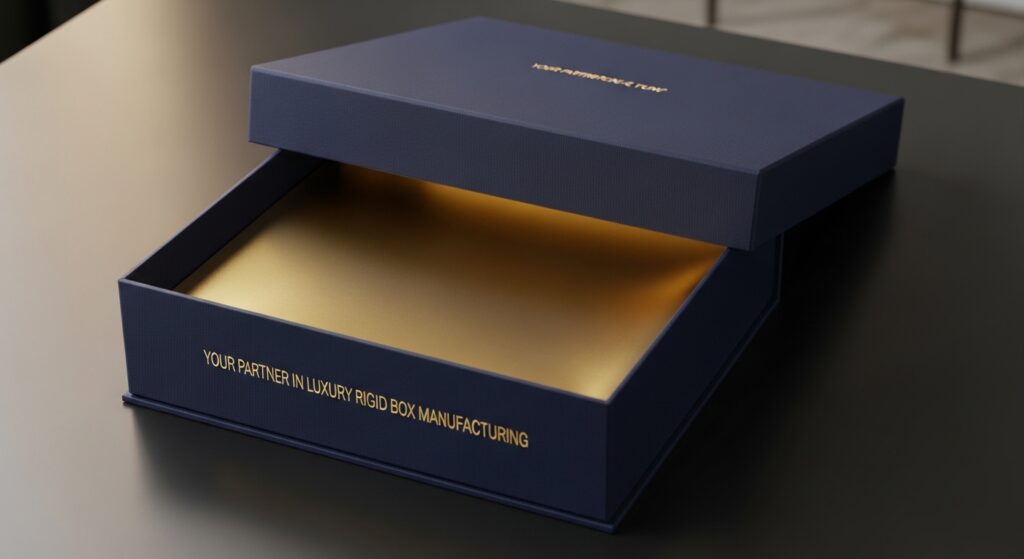
With over two decades of experience, a state-of-the-art facility, and a portfolio of successful global partnerships, we provide the reliability and quality that premium brands demand. Our team is ready to help you navigate the complexities of luxury packaging production.
Request a consultation to develop your custom luxury rigid box solution with our engineering team.