
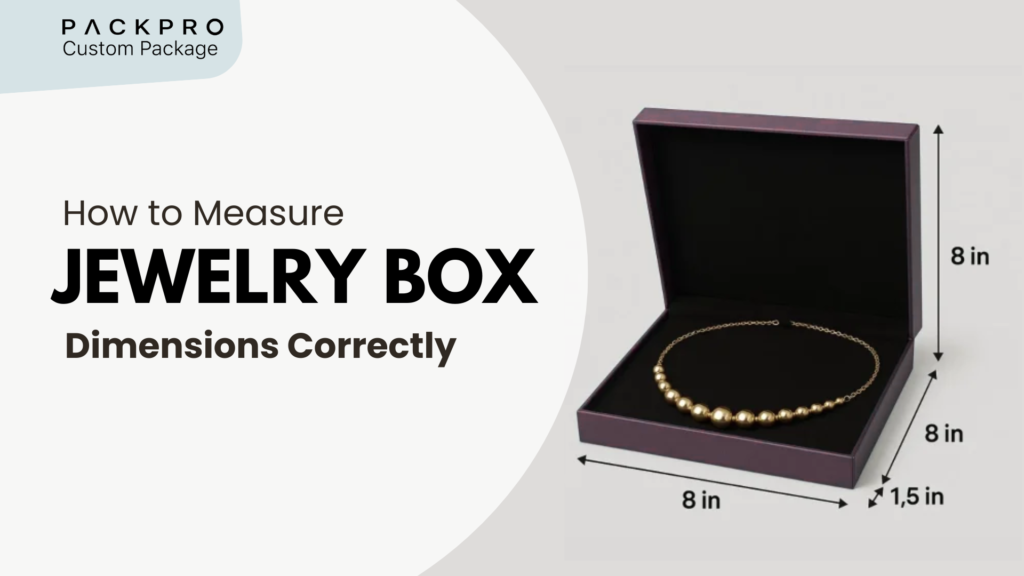
A poorly fitted jewelry box is more than an inconvenience — it can scratch delicate pieces, allow items to move and tangle during shipping, or simply fail to convey the premium experience your customers expect. Getting the dimensions right from the start is essential.
Whether you’re ordering custom jewelry boxes for a product launch or trying to find a standard box that fits your pieces, this guide walks you through exactly how to measure correctly for every type of jewelry.
Understanding Jewelry Box Dimensions: L × W × H
Jewelry box dimensions are always listed in three measurements:
- Length (L) — The longest horizontal measurement of the interior
- Width (W) — The shorter horizontal measurement of the interior
- Height (H) — The depth or vertical measurement of the interior
Important: Always measure the interior dimensions when specifying a box. The exterior will be slightly larger due to wall thickness — usually 1–3mm per wall for folding cartons, and 3–5mm for rigid boxes.
The Golden Rule: Add Clearance to Every Dimension
Never order a box that matches your jewelry’s exact measurements. You need clearance — extra space — for practical and aesthetic reasons:
- Minimum clearance: Add 3–5mm on all sides for simple items like rings and small earrings
- Standard clearance: Add 8–12mm on all sides for most jewelry pieces
- Insert clearance: If you’re adding a foam or velvet insert, measure the insert first, then size the box around it — not around the raw jewelry

How to Measure for Specific Jewelry Types
Ring Boxes
A single ring sits upright in a slot, so the dimensions you need are:
- Measure the ring’s outer diameter (typically 18–22mm)
- Add space for the slot insert — a standard ring slot is about 20–25mm wide and 30–35mm deep
- Box interior typically: 50–60mm L × 50–60mm W × 35–45mm H
For multi-ring boxes, multiply the width by the number of rings plus clearance between slots (minimum 5mm between each).
Necklace Boxes
Necklaces are the most variable jewelry type. The chain length and pendant size both affect the box dimensions needed.
- Lay the necklace flat in a natural coil or curve — measure the bounding rectangle it occupies
- Measure the pendant at its widest point separately — this determines minimum interior height
- Add 10–15mm clearance on all sides
- Typical necklace box range: 150–250mm L × 80–150mm W × 25–40mm H
Bracelet Boxes
Bracelets come in two forms: bangle (rigid ring) and chain (flexible). Measure differently for each:
- Bangle bracelets: Measure the outer diameter. Add 20mm to the diameter for a comfortable pillow insert. Box is typically square with height matching bracelet width plus 10mm.
- Chain bracelets: Lay flat like a necklace, measure the rectangle it fills. Standard chain bracelet box: 90–100mm L × 80–90mm W × 25–35mm H
Earring Boxes
Earrings are typically sold as pairs and displayed side by side on an insert card or foam pad.
- Measure each earring at its longest drop (from hook to bottom of earring)
- Measure the width at the widest point
- The box should be wide enough for both earrings side by side with 10mm between them
- Typical earring box: 70–100mm L × 70–100mm W × 20–30mm H
Watch Boxes
Watches require significantly more depth due to the watch head thickness and the pillow insert.
- Measure strap length (fully extended), watch head diameter, and watch thickness
- Most watch boxes are designed around a standard pillow insert (approximately 90mm diameter)
- Typical single watch box: 130–150mm L × 100–120mm W × 60–80mm H

Standard Jewelry Box Size Reference
| Jewelry Type | Typical Interior Size (L × W × H) | Notes |
|---|---|---|
| Ring (single) | 55 × 55 × 40 mm | Includes slot insert space |
| Ring (double) | 100 × 55 × 40 mm | Two slots side by side |
| Earrings | 80 × 80 × 25 mm | Includes insert card |
| Chain bracelet | 95 × 85 × 30 mm | Flat with insert |
| Bangle bracelet | 95 × 95 × 40 mm | Pillow insert |
| Short necklace | 150 × 100 × 35 mm | Folded with pendant |
| Long necklace | 220 × 120 × 35 mm | Coiled or folded |
| Watch (single) | 140 × 110 × 70 mm | Pillow insert required |

Measuring for Sets and Multi-Piece Boxes
If you’re packaging a jewelry set (necklace + earrings + bracelet), you’ll need to lay all pieces out together in their intended display arrangement, measure the combined bounding area, then add clearance and account for any dividers or inserts between pieces.
Custom foam inserts are highly recommended for multi-piece sets — they hold each piece securely in position and prevent pieces from tangling or scratching each other during transport.
Tips for Getting It Right First Time
- Always use a ruler or calipers — estimating by eye leads to misfit boxes
- Measure the actual insert, not just the jewelry — if you’re using a velvet pad or foam, size the box around the insert
- Order a sample before your full run — even with correct measurements, a physical sample confirms fit and finish before you commit to a large order
- Account for lid depth — in rigid boxes, the lid adds height when closed; ensure the closed box total height works for display and stacking
Final Thoughts
Measuring your jewelry correctly before ordering packaging is a small step that prevents big problems. A perfectly fitted box doesn’t just look professional — it protects your product, elevates your brand, and creates an opening experience your customers will remember.
At PackPro, we manufacture custom jewelry boxes in any size, style, and finish. Our team can help you finalize dimensions and recommend the right insert options for your pieces. Contact us today to get started.
Related Reading
- How to Measure Cake Box Dimensions
- How to Choose the Right Magnetic Closure Gift Box
- Why Custom Rigid Boxes Are Used in Luxury Packaging
Frequently Asked Questions
Should I measure the interior or exterior dimensions when ordering a custom jewelry box?
Always specify interior dimensions when ordering a jewelry box, as these are the measurements that determine whether your jewelry will actually fit. The exterior dimensions will be slightly larger due to wall thickness — typically 1–3mm per wall for folding cartons and 3–5mm per wall for rigid boxes. Providing interior measurements ensures your manufacturer builds the box to the correct fit from the inside out.
How much clearance should I allow inside a jewelry box?
For most jewelry pieces, add 8–12mm of clearance on all sides beyond the jewelry’s actual dimensions. For very small items like rings or stud earrings, a minimum of 3–5mm clearance is acceptable. If you are using a foam or velvet insert, measure the insert dimensions and size the box to fit the insert — not the bare jewelry — since the insert itself takes up space inside the box.
What is the standard box size for a single ring?
A standard single ring box interior measures approximately 55 × 55 × 40mm, which accommodates the ring slot insert and provides enough depth for most ring profiles. For rings with unusually tall settings or very wide bands, you may need to increase the height dimension. For a double ring box holding two rings side by side, a width of approximately 100mm is typical.
How do I measure the correct box size for a necklace?
Lay the necklace flat on a surface in its natural coil or display arrangement and measure the bounding rectangle it occupies. Then measure the pendant separately at its widest point to determine the minimum interior height needed. Add 10–15mm clearance on all sides and use those figures as your interior box dimensions. Typical necklace boxes range from 150–250mm in length and 80–150mm in width.
Why should I order a sample box before committing to a full production run?
Even with precise measurements, a physical sample allows you to confirm that the jewelry fits correctly, that the insert holds the piece securely without movement, and that the overall presentation meets your expectations. Samples also reveal any issues with lid fit, color accuracy, and finish quality before you invest in a full production order, saving significant cost and time if adjustments are needed.